From Troas we put out to sea and sailed straight for Samothrace, and the next day we went on to Neapolis. From there we traveled to Philippi, a Roman colony and the leading city of that district of Macedonia. And we stayed there several days.
On the Sabbath we went outside the city gate to the river, where we expected to find a place of prayer. We sat down and began to speak to the women who had gathered there. One of those listening was a woman from the city of Thyatira named Lydia, a dealer in purple cloth. She was a worshiper of God. The Lord opened her heart to respond to Paul’s message. When she and the members of her household were baptized, she invited us to her home. “If you consider me a believer in the Lord,” she said, “come and stay at my house.” And she persuaded us.
- Acts 16:11-15
“To the angel of the church in Thyatira write:
These are the words of the Son of God, whose eyes are like blazing fire and whose feet are like burnished bronze. I know your deeds, your love and faith, your service and perseverance, and that you are now doing more than you did at first.
Nevertheless, I have this against you: You tolerate that woman Jezebel, who calls herself a prophet. By her teaching she misleads my servants into sexual immorality and the eating of food sacrificed to idols. I have given her time to repent of her immorality, but she is unwilling. So I will cast her on a bed of suffering, and I will make those who commit adultery with her suffer intensely, unless they repent of her ways. I will strike her children dead. Then all the churches will know that I am he who searches hearts and minds, and I will repay each of you according to your deeds.
Now I say to the rest of you in Thyatira, to you who do not hold to her teaching and have not learned Satan’s so-called deep secrets, ‘I will not impose any other burden on you, except to hold on to what you have until I come.’
To the one who is victorious and does my will to the end, I will give authority over the nations—that one ‘will rule them with an iron scepter and will dash them to pieces like pottery’—just as I have received authority from my Father. I will also give that one the morning star. Whoever has ears, let them hear what the Spirit says to the churches.
- Revelation 2:18-29
Then Jesus said to his disciples, “Truly I tell you, it is hard for someone who is rich to enter the kingdom of heaven. Again I tell you, it is easier for a camel to go through the eye of a needle than for someone who is rich to enter the kingdom of God.”
When the disciples heard this, they were greatly astonished and asked, “Who then can be saved?”
Jesus looked at them and said, “With man this is impossible, but with God all things are possible.”
- Matthew 19:23-26
I may be drawing lines that are not there, but when I was In India in 1998, I spent a month working at a steel mill. Due to the work, the problems we had, and me being the designated member of the team who would talk to the customer directly, that is the management, I sometimes went to work at 4:00 or 5:00 in the morning, and often stayed at work until midnight. I was supposedly assigned to straight days, since that was when the top management would be there to ask questions.
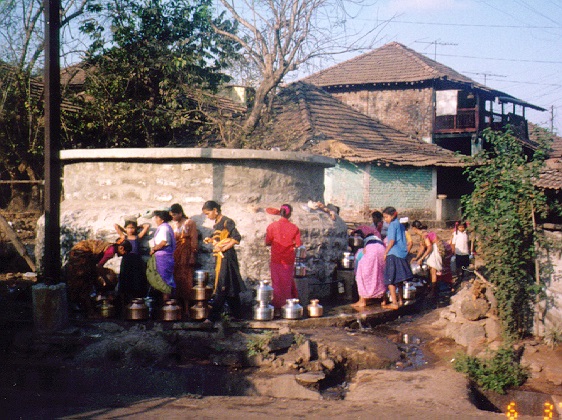
This allowed me the opportunity to watch the gypsy women in their morning routine. Far before dawn, they took their clothing to the river to wash clothes. They then found dry wood, maybe miles from their camp, so that their husband could start a fire (and probably wake him up also). Wood collecting was about dawn. Then, as the husband had a modest fire going, they would go to the nearest well and draw water. With water and a nice fire, a small amount of rice would be cooked for each family member. Only those less than seven-years-old were allowed to not work, but I saw five- and six-year-olds stringing hammocks for their baby siblings at the work site.
You can be shocked by all that, but it was life there. The men got the equivalent of one US dollar, even if they were seven years old. The women, who had already worked a half day washing clothes and gathering firewood and water, got about eighty percent of the men’s wages or 80 cents. Again, you might be shocked, but that was life there and in many countries.
My point was that the Scripture from Acts 16 said that Paul and his crew went to the river to find a place where they could pray. Philippi was a Roman city, built along the river and at a Roman road intersecting point. There was no synagogue for Paul to do his usual thing. So, why not? Let’s go early in the morning to the river to pray. God had given Paul a vision that the people in Macedonia needed him. So, go to the river to pray and God will answer that prayer.
I love going to rivers or even small brooks, runs, creeks, whatever you call them. The air seems clean, especially in remote areas. The trickle of the water over the rocks is a wonderful white noise. I feel closer to God there.
All the Scripture says is the Paul started preaching to the women that had gathered by the river. Then there was one in particular, Lydia. But from my experience watching other people at work, specifically gypsy women in India, I thought, ‘Why would the women be at the river at that time?’ To wash clothing. Without clocks to punch at work. They could wash clothing after the sun had risen, or at least at sunrise.
So, here were the women, washing clothes, and this man starts to preach to them. We know that this starts a church. The women must have gone home and told their husbands that they were there in their skimpy clothing, washing clothes and this man came along and preached about a God who would forgive them of their sins. The men must have tagged along, just to make sure these strange Jews did not molest their women. And from that, a church was formed.
But all the Scripture says is that the household of Lydia all believed and were baptized, and Lydia insisted that Paul and his crew stay at her house outside town. Lydia was not just rich, she was probably stinking rich. After all, she sold purple. Only the rich could afford purple. It was a royal color in that royalty were usually the only ones who could afford it.
I heard of a prosthetic hip and knee salesman. He was far richer than the surgeons, who had to pay malpractice insurance and a staff of assistants. So, I can imagine that Lydia was extremely wealthy.
Lydia was from Thyatira. I was disjointed in my thinking for a long time, thinking that Thyatira was a suburb of Philippi, but Thyatira was a city in Asia Minor. The fourth of the seven letters to the churches in Revelation was to Thyatira. This note in Acts was to say that Lydia had moved to Macedonia, maybe chasing a more wealthy clientele.
But she was at the river along with the other women. There would be no customers there. The servants of Lydia’s customers in Philippi probably washed clothes at the river later on, after the morning rush. The rich folk that wore purple probably had more than one purple toga or robe.
Lydia was there, as I can only logically surmise, for the same reason the other women were there.
Lydia washed her own clothing.
The Scriptures say she had a household. There were others who could do the laundry.
Jesus said that it is easier for a camel to go through the eye of a needle than it is for a rich person to enter the kingdom of heaven. But then He clarifies that by saying that anything is possible with God.
And how was it possible with Lydia? She was already humble enough to go to the river at dawn and wash her own clothing, and maybe the clothing of others in her household. When we let go of our pride to realize that no matter how wonderful we think we might be, God is so much greater that our foolish pride is laughable. But Lydia had already overcome that hurdle. And that made her heart receptive to the message of the Gospel.
These interpolations of the life of Lydia are all my own. I think I have quoted all the references to Lydia and practically all for Thyatira. Interpolations and extrapolations and maybe a lot of imagination are required to make much of a story about her. But in understanding the Gospel and how God has worked within the lives of family, friends, and me, it makes sense. Just don’t quote it as if it was fact.
Soli Deo Gloria. Only to God be the Glory.
 Thoughts from Mark "Hat" Rackley
Leave a comment