Where then does wisdom come from?
Where does understanding dwell?
It is hidden from the eyes of every living thing,
concealed even from the birds in the sky.
Destruction and Death say,
“Only a rumor of it has reached our ears.”
God understands the way to it
and he alone knows where it dwells,
for he views the ends of the earth
and sees everything under the heavens.
When he established the force of the wind
and measured out the waters,
when he made a decree for the rain
and a path for the thunderstorm,
then he looked at wisdom and appraised it;
he confirmed it and tested it.
And he said to the human race,
“The fear of the Lord—that is wisdom,
and to shun evil is understanding.”
- Job 28:20-28
She
I am a rose of Sharon,
a lily of the valleys.
He
Like a lily among thorns
is my darling among the young women.
She
Like an apple tree among the trees of the forest
is my beloved among the young men.
I delight to sit in his shade,
and his fruit is sweet to my taste.
- Song of Songs 2:1-3
“What’s in a name? That which we call a rose by any other word would smell as sweet.”
- William Shakespeare, Romeo and Juliet
“Neither logic nor science can explain the sublimities of Nature. Supposing a scientist with a diseased olfactory nerve says that there is no perfume in a rose, and to prove his statement he dissects the rose and tabulates every part, and then says, ‘Where is the perfume? It is a fiction; I have demonstrated that there is none.’ There is always one fact more that science cannot explain, and the best thing to do is not to deny it in order to preserve your sanity, but to say, as Job did, ‘No, the one fact more which you cannot explain means that God must step in just there, or there is no explanation to be had.’
“Every common-sense fact requires something for its explanation which common-sense cannot give. The facts of every day and night reveal things our own minds cannot explain. When a scientific man comes across a gap in his explanations, instead of saying, ‘There is no gap here’, let him recognize that there is a gap he cannot bridge, and that he must be reverent with what he cannot understand. The tendency is to deny that a fact has any existence because it cannot be fitted into any explanation as yet. That ‘the exception proves the rule’ is not true: the exception proves that the rule won’t do; the rule is only useful in the greatest number of cases. When scientists treat a thesis as a fact they mean that it is based on the highest degree of probability. There are no ‘infallible’ findings, and the man who bows down to scientific findings may be as big a fool as the man who refuses to do so. The man who prays ceases to be a fool, while the man who refuses to pray nourishes a blind life within his own brain and he will find no way out that road. Job cries out that prayer is the only way out in all these matters.”
- Oswald Chambers, Daily Thoughts for Disciples (May 1, from Baffled to Fight Better)
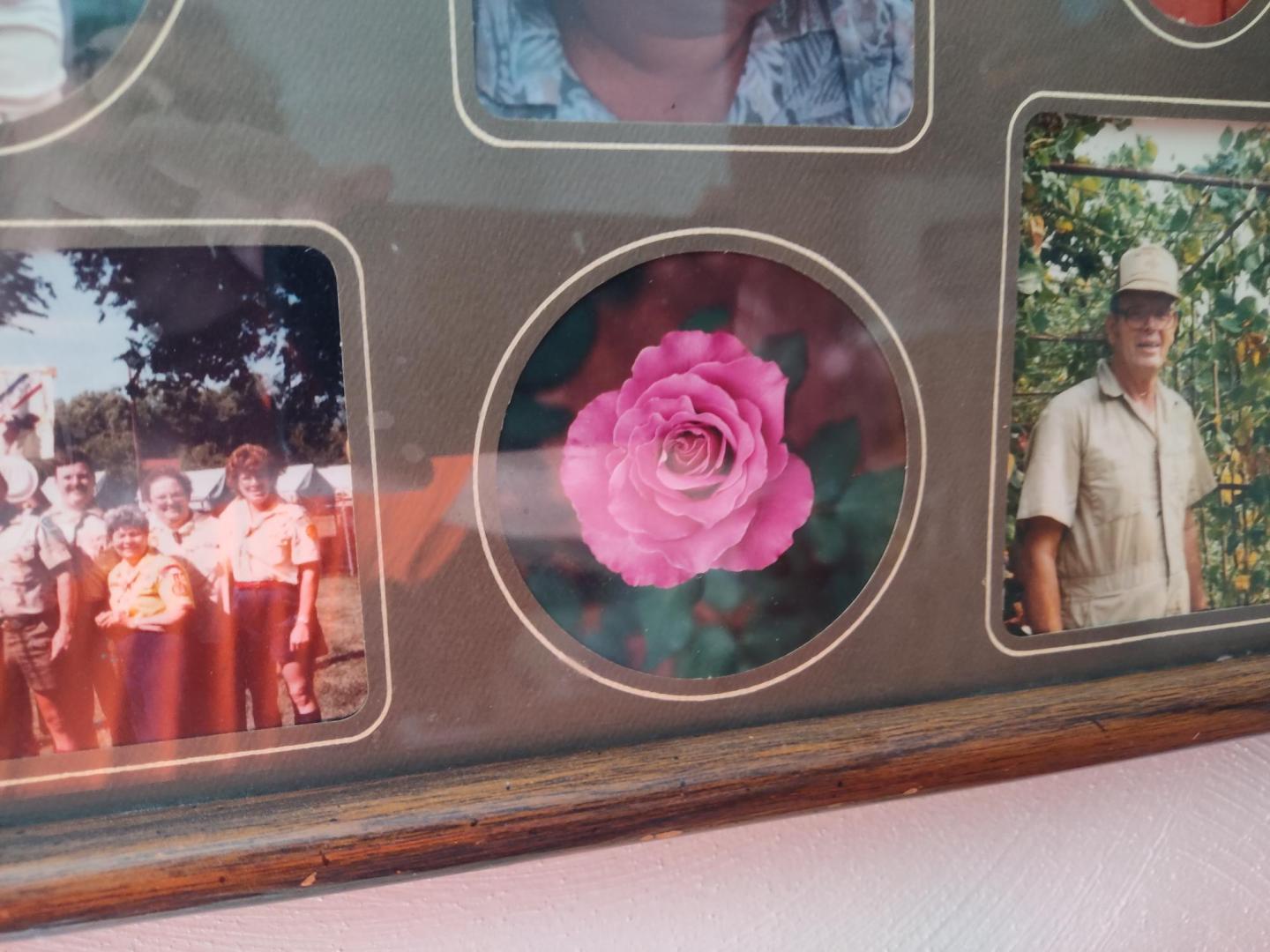
Before I get started, the rose in the photograph of a photograph is from Edisto Memorial Gardens in Orangeburg, South Carolina. The frame for the photograph, containing a variety of photographs that covered about ten years, has sat next to my wife’s closet for over twenty-five years and I did not have the heart to take it down, pull out the one photo, and then scan it. But as for the rose photo, the garden borders the eastern shore of the north fork of the Edisto River. The best time to visit the garden is when the azaleas are in bloom, but their rose garden was growing over the ten years we lived north of there. We stopped often when either going to Charleston, SC or to a beach, like Edisto Beach, our favorite in that area.
There is so much in these quotes. There was a typo in my copy of Daily Thoughts for Disciples. It quoted Job correctly, but the book said Job 4 instead of Job 28. Job 4 ends with a statement about wisdom, but for a moment, I was confused, for there is no verse 28 in Job 4. But this discourse in Job 28 is Job’s last statement to his friends, which goes on for a few chapters. Then Elihu walks up to join Job and the three other friends.
Then, for the steamy Song of Songs quote, this may be the only reference to a “rose” in the Bible. The word “rose” appears in nearly every book of the Bible, but in the form of “He rose early”, “the sun rose”, “God’s wrath rose”, etc. But even then, the woman in this “words of endearment” conversation is saying that she is but a weed. Most scholars agree this is a mistranslation for the Hebrew word, and a crocus is more appropriate. If “rose of Sharon” is the term, then “She” is calling herself a common hibiscus, specifically hibiscus syriacus, since it was commonly cultivated in Syria. That would make her a common deciduous bush. But if crocus is a better translation, the crocus is a tiny flower that blooms early and quickly dies away, but it is a mighty flower, in that it can break through the snow to share its beauty with the world. The lilies of the valley may be a showy weed, but a weed nonetheless.
“He” corrects her humility by saying that “She” is a wonderful bloom among the thorns, at least, to “Him.”
But then, we come to Shakespeare who asks “What is in a name?” This is followed by Oswald Chambers who postulates that to someone who cannot smell, roses have no sweet smell at all.
So, I could go into those people who, years after ‘recovering’ from COVID 19, have yet to smell certain smells.
But the scientist that could not smell the rose is like the cosmonauts who returned to earth and taunted all those who believe in a God in that they went to “heaven” and there was no God there. Of course, God is a spirit, and God is as much in the universe as God is in us and around us. God is everywhere, but you only see Him through His creation.
But in Chambers’ discussion about dissecting the rose and finding no perfume, it reminds me of scientists that argue that the soul does not exist, and that consciousness is something for which they have no answer. What makes us sentient?
But my mind wandered, as if this post is anything other than wandering. As Bill Gaither said when he was telling a story once, “Don’t worry. This story is circling. Sooner or later, it might come in for a landing.” But where was I?
Oh, yeah, my mind wandered to my freshman chemical engineering class when the professor told us that when we measured something, we should be as accurate as we could be, to a reasonable sense, and we should know what other factors might affect our measurements. He used a common measurement scale and its invention as an example.
Daniel Gabriel Fahrenheit postulated, with no true science to back it up, that water should freeze at zero degrees on a scale, Fahrenheit’s wife should have a body temperature of 100 degrees and the boiling point of water should be 200 degrees. Okay, he tried and tried, but after he had pinpointed his 100 degrees and 200 degrees measurements, he could not get water to freeze at anything other than 32 degrees Fahrenheit. Fahrenheit learned that to make a scale of this nature, Nature is going to win if you come up with more than two fixed points.
But you are asking, what about a normal body temperature of 98.6? What about water boiling at 212? Fahrenheit got none of it right!
Maybe his wife was ill at the time he measured her temperature? He might have been very accurate, but he misunderstood the information he received.
And water boiling at 212F, you have to be a normal atmospheric pressure. If Fahrenheit was in the mountains, water would boil at a temperature less than 212. If there was a terrible storm brewing and the Low Pressure system was camped over Fahrenheit’s mountain laboratory, the boiling point of water could be even lower.
But then again, maybe he was sloppy in taking his measurements. Regardless, the professor’s point was for us to know our conditions surrounding whatever it was that we were measuring.
That is the problem Job faced, as do we all, when we try to seek God’s perfect wisdom. But in Job 28:28, Job gets to the heart of the matter. Fear the Lord and shun evil and God reveals His wisdom to us.
But in doing that, it would take a lifetime.
Now for the patience and the attention span for that fearing the Lord and shunning evil to work. …
I hope all my circling has led to a safe landing.
But how did Chambers come in for a landing? Prayer. Yep, patience, an attention span, and even wisdom start with trusting God, reading the Bible and praying, a lot of prayer.
Soli Deo Gloria. Only to God be the Glory.
 Thoughts from Mark "Hat" Rackley
Leave a comment