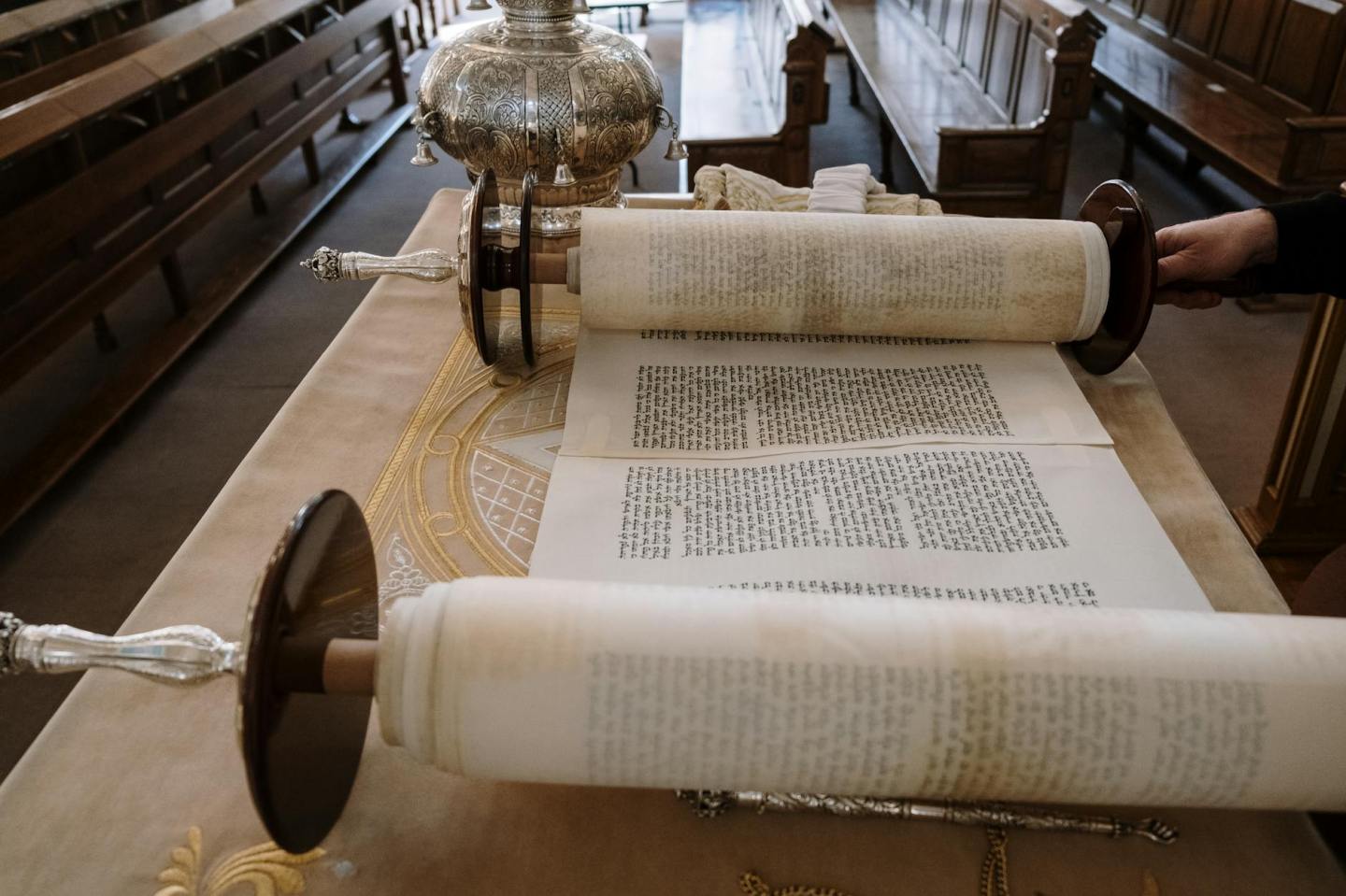
all the people came together as one in the square before the Water Gate. They told Ezra the teacher of the Law to bring out the Book of the Law of Moses, which the Lord had commanded for Israel.
So on the first day of the seventh month Ezra the priest brought the Law before the assembly, which was made up of men and women and all who were able to understand. He read it aloud from daybreak till noon as he faced the square before the Water Gate in the presence of the men, women and others who could understand. And all the people listened attentively to the Book of the Law.
Ezra the teacher of the Law stood on a high wooden platform built for the occasion. Beside him on his right stood Mattithiah, Shema, Anaiah, Uriah, Hilkiah and Maaseiah; and on his left were Pedaiah, Mishael, Malkijah, Hashum, Hashbaddanah, Zechariah and Meshullam.
Ezra opened the book. All the people could see him because he was standing above them; and as he opened it, the people all stood up. Ezra praised the Lord, the great God; and all the people lifted their hands and responded, “Amen! Amen!” Then they bowed down and worshiped the Lord with their faces to the ground.
The Levites—Jeshua, Bani, Sherebiah, Jamin, Akkub, Shabbethai, Hodiah, Maaseiah, Kelita, Azariah, Jozabad, Hanan and Pelaiah—instructed the people in the Law while the people were standing there. They read from the Book of the Law of God, making it clear and giving the meaning so that the people understood what was being read.
Then Nehemiah the governor, Ezra the priest and teacher of the Law, and the Levites who were instructing the people said to them all, “This day is holy to the Lord your God. Do not mourn or weep.” For all the people had been weeping as they listened to the words of the Law.
Nehemiah said, “Go and enjoy choice food and sweet drinks, and send some to those who have nothing prepared. This day is holy to our Lord. Do not grieve, for the joy of the Lord is your strength.”
The Levites calmed all the people, saying, “Be still, for this is a holy day. Do not grieve.”
Then all the people went away to eat and drink, to send portions of food and to celebrate with great joy, because they now understood the words that had been made known to them.
On the second day of the month, the heads of all the families, along with the priests and the Levites, gathered around Ezra the teacher to give attention to the words of the Law. They found written in the Law, which the Lord had commanded through Moses, that the Israelites were to live in temporary shelters during the festival of the seventh month and that they should proclaim this word and spread it throughout their towns and in Jerusalem: “Go out into the hill country and bring back branches from olive and wild olive trees, and from myrtles, palms and shade trees, to make temporary shelters”—as it is written.
So the people went out and brought back branches and built themselves temporary shelters on their own roofs, in their courtyards, in the courts of the house of God and in the square by the Water Gate and the one by the Gate of Ephraim. The whole company that had returned from exile built temporary shelters and lived in them. From the days of Joshua son of Nun until that day, the Israelites had not celebrated it like this. And their joy was very great.
Day after day, from the first day to the last, Ezra read from the Book of the Law of God. They celebrated the festival for seven days, and on the eighth day, in accordance with the regulation, there was an assembly.
- Nehemiah 8:1-18
On the twenty-fourth day of the same month, the Israelites gathered together, fasting and wearing sackcloth and putting dust on their heads. Those of Israelite descent had separated themselves from all foreigners. They stood in their places and confessed their sins and the sins of their ancestors. They stood where they were and read from the Book of the Law of the Lord their God for a quarter of the day, and spent another quarter in confession and in worshiping the Lord their God. Standing on the stairs of the Levites were Jeshua, Bani, Kadmiel, Shebaniah, Bunni, Sherebiah, Bani and Kenani. They cried out with loud voices to the Lord their God. And the Levites—Jeshua, Kadmiel, Bani, Hashabneiah, Sherebiah, Hodiah, Shebaniah and Pethahiah—said: “Stand up and praise the Lord your God, who is from everlasting to everlasting.”
“Blessed be your glorious name, and may it be exalted above all blessing and praise. You alone are the Lord. You made the heavens, even the highest heavens, and all their starry host, the earth and all that is on it, the seas and all that is in them. You give life to everything, and the multitudes of heaven worship you.
“You are the Lord God, who chose Abram and brought him out of Ur of the Chaldeans and named him Abraham. You found his heart faithful to you, and you made a covenant with him to give to his descendants the land of the Canaanites, Hittites, Amorites, Perizzites, Jebusites and Girgashites. You have kept your promise because you are righteous.
“You saw the suffering of our ancestors in Egypt; you heard their cry at the Red Sea. You sent signs and wonders against Pharaoh, against all his officials and all the people of his land, for you knew how arrogantly the Egyptians treated them. You made a name for yourself, which remains to this day. You divided the sea before them, so that they passed through it on dry ground, but you hurled their pursuers into the depths, like a stone into mighty waters. By day you led them with a pillar of cloud, and by night with a pillar of fire to give them light on the way they were to take.
“You came down on Mount Sinai; you spoke to them from heaven. You gave them regulations and laws that are just and right, and decrees and commands that are good. You made known to them your holy Sabbath and gave them commands, decrees and laws through your servant Moses. In their hunger you gave them bread from heaven and in their thirst you brought them water from the rock; you told them to go in and take possession of the land you had sworn with uplifted hand to give them.
“But they, our ancestors, became arrogant and stiff-necked, and they did not obey your commands. They refused to listen and failed to remember the miracles you performed among them. They became stiff-necked and in their rebellion appointed a leader in order to return to their slavery. But you are a forgiving God, gracious and compassionate, slow to anger and abounding in love. Therefore you did not desert them, even when they cast for themselves an image of a calf and said, ‘This is your god, who brought you up out of Egypt,’ or when they committed awful blasphemies.
“Because of your great compassion you did not abandon them in the wilderness. By day the pillar of cloud did not fail to guide them on their path, nor the pillar of fire by night to shine on the way they were to take. You gave your good Spirit to instruct them. You did not withhold your manna from their mouths, and you gave them water for their thirst. For forty years you sustained them in the wilderness; they lacked nothing, their clothes did not wear out nor did their feet become swollen.
“You gave them kingdoms and nations, allotting to them even the remotest frontiers. They took over the country of Sihon king of Heshbon and the country of Og king of Bashan. You made their children as numerous as the stars in the sky, and you brought them into the land that you told their parents to enter and possess. Their children went in and took possession of the land. You subdued before them the Canaanites, who lived in the land; you gave the Canaanites into their hands, along with their kings and the peoples of the land, to deal with them as they pleased. They captured fortified cities and fertile land; they took possession of houses filled with all kinds of good things, wells already dug, vineyards, olive groves and fruit trees in abundance. They ate to the full and were well-nourished; they reveled in your great goodness.
“But they were disobedient and rebelled against you; they turned their backs on your law. They killed your prophets, who had warned them in order to turn them back to you; they committed awful blasphemies. So you delivered them into the hands of their enemies, who oppressed them. But when they were oppressed they cried out to you. From heaven you heard them, and in your great compassion you gave them deliverers, who rescued them from the hand of their enemies.
“But as soon as they were at rest, they again did what was evil in your sight. Then you abandoned them to the hand of their enemies so that they ruled over them. And when they cried out to you again, you heard from heaven, and in your compassion you delivered them time after time.
“You warned them in order to turn them back to your law, but they became arrogant and disobeyed your commands. They sinned against your ordinances, of which you said, ‘The person who obeys them will live by them.’ Stubbornly they turned their backs on you, became stiff-necked and refused to listen. For many years you were patient with them. By your Spirit you warned them through your prophets. Yet they paid no attention, so you gave them into the hands of the neighboring peoples. But in your great mercy you did not put an end to them or abandon them, for you are a gracious and merciful God.
“Now therefore, our God, the great God, mighty and awesome, who keeps his covenant of love, do not let all this hardship seem trifling in your eyes—the hardship that has come on us, on our kings and leaders, on our priests and prophets, on our ancestors and all your people, from the days of the kings of Assyria until today. In all that has happened to us, you have remained righteous; you have acted faithfully, while we acted wickedly. Our kings, our leaders, our priests and our ancestors did not follow your law; they did not pay attention to your commands or the statutes you warned them to keep. Even while they were in their kingdom, enjoying your great goodness to them in the spacious and fertile land you gave them, they did not serve you or turn from their evil ways.
“But see, we are slaves today, slaves in the land you gave our ancestors so they could eat its fruit and the other good things it produces. Because of our sins, its abundant harvest goes to the kings you have placed over us. They rule over our bodies and our cattle as they please. We are in great distress.
“In view of all this, we are making a binding agreement, putting it in writing, and our leaders, our Levites and our priests are affixing their seals to it.”
- Nehemiah 9:1-38
For a link to Ezra 10, click HERE.
Noted Biblical Scholars, Teachers, and Preachers Comments
Nehemiah 8:1-2 ‘The Book … the Law’: “In response to the people’s request, Ezra brought the Law of the Lord, which he had set his heart to study, practice, and teach to the people (cf. Ezra 7:10). At this time, the law was written on a scroll, as opposed to a text consisting of bound pages. Such a reading was required every seven years at the Feast of Tabernacles (cf. Deut. 31:10-13), even though it had been neglected since the Babylonian captivity until this occasion.”
- John MacArthur, John MacArthur Commentary (quoted Scripture without bold/italics)
Nehemiah 8:4 ‘platform … beside him’: “The platform was big enough to hold fourteen people for the long hours of reading and explaining (v. 8). The men, probably priests, stood with Nehemiah to show agreement.”
- John MacArthur, John MacArthur Commentary (quoted Scripture without bold/italics)
Nehemiah 8:5-6 ‘Ezra starts reinstruction’: ”The latter part of the book, chapters 7 through 13, is the story of the reinstruction of the people. The city has been strengthened and fortified; now it’s time to strengthen and fortify the people, so that the nation of Israel can remain strong. In chapter 8, we have the great convening of the people by Ezra the priest—an event that is also recorded in the book of Ezra. Notice the steps here. Ezra begins by reading the law before the people (8:5-6)…
“What is Ezra doing here? It’s called ‘expository preaching.’ This form of preaching differs from ‘topical preaching,’ which is preaching on a certain topic or subject. Expository preaching ‘throws light’ (or exposes) the meaning and application in a particular passage of Scripture. So Ezra is ‘throwing light’ on the Word of God and making its meaning clear to the people, so that the walls of their lives would be strengthened.
“After Ezra preached, the people celebrated the Feast of the Tabernacles, commemorating when the people of Israel camped in booths made of tree boughs to remind them that they were strangers and pilgrims on this earth.”
- Ray C. Stedman, Adventuring Through the Bible
Nehemiah 8:8 ‘gave the sense’: “This may have involved translation for people who were only Aramaic speakers in exile but, more likely, it means ‘to break down’ the text into its parts so that the people could understand it. This was an exposition or explanation of the meaning and not just translation. helped them to understand the reading. In this act of instruction, Ezra’s personal commitment to study the law, practice it in his own life, and then teach it (Ezra 7:10) was reflected.”
- John MacArthur, John MacArthur Commentary (quoted Scripture without bold/italics)
Nehemiah 8:10 ‘Grief followed by gladness’: “Holy sorrow is precious before God and is no bar to godly joy. Abounding mourning is no reason there should not speedily be seen an equally abundant joy, for the people who were told by Nehemiah and Ezra to rejoice were even then melted with penitential grief: ‘All the people were weeping as they heard the words of the law’ (v. 9). The vast congregation before the water gate, under the teaching of Ezra, were awakened and cut to the heart; they felt the edge of the law of God like a sword opening up their hearts, fearing, cutting, and killing, and well might they lament. But that was the time to let them feel the gospel‘s balm and hear the gospel’s music; and, therefore, the former sons of thunder channeled their notes and became sons of consolation. Now that they were penitent and sincerely turned to their God, they were told to rejoice. As certain fabrics need to be dampened before they will take the glowing colors with which they are to be adorned, so our spirits need the grace of repentance before they can receive the radiant coloring of delight. The glad news of the gospel can only be printed on wet paper. ls there ever seen clearer shining than that which follows a shower? Then the sun transforms the raindrops into gems, the flowers look up with fresher smiles and faces glittering from their refreshing bath, and the birds from among the dripping branches sing with notes more rapturous because they have paused awhile. So when the soul has been saturated with the rain of penitence, the clear shining of forgiving love makes the flowers of gladness blossom all around. The steps by which we ascend to the palace of delight are usually moist with tears. Grief for sin is the porch of the house where the guests are full of ‘the joy of the Lord.’ As Jesus said in the Sermon on the Mount, ‘Blessed are those who mourn, for they will be comforted’ (Mt. 5:4).”
- Charles H. Spurgeon, from sermon notes
Nehemiah 8:10 ‘Illustrations’: “As certain fabrics need to be dampened before they will take the glowing colors with which they are to be adorned, so our spirits need the grace of repentance before they can receive the radiant coloring of delight. The glad news of the gospel can only be printed on wet paper. Is there ever seen clearer shining than that which follows a shower? Then the sun transforms the raindrops into gems, the flowers look up with fresher smiles and faces glittering from their refreshing bath, and the birds from among the dripping branches sing with notes more rapturous because they have paused awhile. So when the soul has been saturated with the rain of penitence, the clear shining of forgiving love makes the flowers of gladness blossom all around. The steps by which we ascend to the palace of delight are usually moist with tears.”
- Charles H. Spurgeon, from sermon notes
Nehemiah 8:13 ‘in order to understand the words of the Law’: “The smaller group that gathered to Ezra consisted of those who had teaching responsibilities: the heads of the father’s houses to their families, and the priests and Levites to the general population in the community (Mal. 2:6, 7).”
- John MacArthur, John MacArthur Commentary (quoted Scripture without bold/italics
Nehemiah 8 ‘Challenge’: “The childish clamor after happiness can become a real snare. One may easily deceive himself by cultivating a religious joy without a correspondingly righteous life. No man should desire to be happy who is not at the same time holy. He should spend his efforts in seeking to know and do the will of God, leaving to Christ the matter of how happy he shall be.
“For those who take this whole thing seriously I have a suggestion. Go to God and have an understanding. Tell Him that it is your desire to be holy at any cost and then ask Him never to give you more happiness than holiness. When your holiness becomes tarnished, let your joy become dim. And ask Him to make you holy whether you are happy or not. Be assured that in the end you will be as happy as you are holy; but for the time being let your whole ambition be to serve God and be Christlike. If we are to take a stand like that we may expect to know a new degree of inward purification and, God being who He is, we are more than likely to know a new degree of happiness as well, but a happiness that springs out of a more intimate fellowship with God, a happiness that is elevated and unselfish and free from the carnal drawings of the flesh.”
- A. W. Tozer, The Price of Neglect
Nehemiah 9:2 ‘separated themselves from all foreigners’: “This call for divorcing all lawful wives taken from among the heathen was needed, since the last time, prompted thirteen years before by Ezra (see notes on Ezra 10), had only been partially successful. Many had escaped the required action of divorce and kept their pagan wives. Perhaps new defaulters had appeared also, and were confronted for the first time with this necessary action of divorce. Nehemiah’s efforts were successful in removing this evil mixture.”
- John MacArthur, John MacArthur Commentary (quoted Scripture without bold/italics)
Nehemiah 9:3 ‘they stood … read … confessed and worshipped’: “The succession of events helped to reestablish the essential commitment of Israel to God and His law. They read for three hours about the sins of their fathers and for three more hours confessed that they had done similar evil deeds. In response to all of this, the people worshiped.”
- John MacArthur, John MacArthur Commentary (quoted Scripture without bold/italics)
Nehemiah 9:6 ‘have made heaven’: “The recitation was sequenced historically, although themes of promise and judgment are traced throughout Israel’s history with God. The first feature is the celebration of God’s greatness as Creator (cf. Gen. 1; 2). The host of heaven worships You. The praise which Israel offered on earth was also echoed in the heavens by angelic hosts.”
- John MacArthur, John MacArthur Commentary (quoted Scripture without bold/italics)
Nehemiah 9:17 ‘No light within us, except from God’: “If we search ourselves through and through, we cannot find anything in our fallen nature that can recommend us to the Most High. If we think we have a claim on God’s goodness, we are in darkness and deceive ourselves. When the true light of God comes, it reveals our barrenness of all merit or excuse and shows that there is nothing in human nature but that which provokes the Lord. This is the fact as to our condition while we are unregenerate; yet often the true believer, when darkness gathers around, finds himself to be in much the same condition. Evidences burn dimly, the candle of the Lord seems quenched, and worst of all the sun of divine favor is not discernible. Then, groping all around, we can discover nothing in ourselves but what causes us to sigh and groan, and in such a plight we should cast overboard the great anchor of faith and escape from ourselves to our God. It is well for us always to do so but especially in the cloudy and dark day. To whom should we turn for light but to the Son of Righteousness? Where can we look for grace but to the God of all grace? If what I am makes me despair, let me consider what God in Christ is, and I will have hope. He is ‘a forgiving God.’ He does not have to be persuaded to forgive. He is a God willing, and more than willing—ready, standing prepared to be gracious. We have a God who stands like a host at a feast that is all provided and prepared, saying, ‘My oxen and my fattened cattle have been slaughtered, and everything is ready. Come to the wedding banquet’ (Mt. 22:4). Not only are all things ready, but God himself is ready. ‘The LORD is waiting to show you mercy, and is rising up to show you compassion’ (Is. 30:18).”
- Charles H. Spurgeon, from sermon notes
Nehemiah 9:21 ‘They lacked nothing’: “The same word is used in Psalm 23:1, ‘I shall not want.’ Even during the long season of chastisement, God miraculously cared for their every need.”
- John MacArthur, John MacArthur Commentary (quoted Scripture without bold/italics)
Nehemiah 9 ‘Remembering God’s Favor and Pledging Obedience’: ”Next came the remembrance of the lessons of the past. In chapter 9, Ezra offered a prayer recounting what God had done in the life of the Israelites. You will always be encouraged and strengthened when you pause to remember what God has done for you in the past.
“Following this prayer, the people signed a covenant and agreed to obey the law of God. They resolved to take the step of obedience. I can tell you from my own experience that you will never be able to retain the strength of God in your life until you are ready to obey Him.”
- Ray C. Stedman, Adventuring Through the Bible
Nehemiah 10:29 ‘a curse and an oath’: “Covenants characteristically were ratified by an oath ceremony in which the parties swore to the terms of the covenant. A curse rite was often included wherein the slaughtering of an animal indicated similar consequences for the covenant breaker. Israel’s pledged adherence to the law was thus solemnly affirmed.”
- John MacArthur, John MacArthur Commentary (quoted Scripture without bold/italics)
Nehemiah 10:30 ‘not give our daughters … nor take their daughters’: “Parents controlled marriages, so this part of the covenant came from them. Again, it emphasized the serious sin of marrying a heathen from an idolatrous people (see Ezra 10).”
- John MacArthur, John MacArthur Commentary (quoted Scripture without bold/italics)
Nehemiah 10:35-37 ‘firstfruits … firstborn … firstborn’: “These laws required the firstfruits of the ground (see Ex. 23:19; 34:26; Deut. 26:2), the firstfruits of the trees (see Lev. 19:24; Num. 18: 13), the firstborn sons redeemed by the estimated price of the priest (see Num. 18:15), and the firstborn of the herds and flocks (see Ex. 13:12; Num. 18:15, 17). All of this was kept at the storehouses near the temple and distributed for the support of the priests and Levites. The Levites then gave a tenth of what they received to the priests (cf. Num. 18:26).”
- John MacArthur, John MacArthur Commentary (quoted Scripture without bold/italics)
My Thoughts
Nehemiah 8 starts with the second half of the sentence that ended Nehemiah 7, thus the first letter is not capitalized. Those who made these divisions placed some unfortunate divisions (not part of the divinely inspired Scriptures but making it easier to negotiate the text).
Ezra brought out the Word of God on scrolls and read the Law to the people. The people had gathered outside the water gate and a platform was built so that Ezra would be above them, along with several leaders of the people and priests. Among the people were men, women, and those who could understand. They had been separated from their foreigner neighbors, so those that could understand were probably the older children, or as some of the scholars suggest, Jews who did not understand Hebrew (since Aramaic was the business language established by Babylon – as was koine Greek by Alexander the Great and used by Rome).
The people bowed to the ground and wept at hearing how they had not been worshipping correctly. The priests explained to them the meaning behind these rules so that everyone understood. The priests then said that this was a day of celebration and weeping was not allowed. They were to celebrate and give to neighbors who did not have enough for a celebration.
They celebrated the Feast of the Tabernacles properly for the first time since the days of Joshua. They had homes, but they set up temporary structures (booths or tabernacles) on their rooves or in their courtyards or common areas and lived in them and celebrated for seven days. They confessed their sin. They wore sackcloth and had dust on their heads. Again, the priests were teaching them.
Then they assembled and they were given a brief history from Abraham to the time of the judges, and all their sin. But through everything, God showed His power, but He showed Mercy to His people. God showed compassion. He warned the people of what was to come, but the people became stiff-necked and refused to repent.
When this history lesson was recited, the people drew up an agreement and the leaders who placed their seal upon the agreement were named in Nehemiah 10.
Nehemiah 10 ends with the rules that the returned remnant swore to follow. The major rules were to keep themselves pure, remember the Sabbaths and Religious Holidays, and give to the maintenance of the Temple and to the Levites. They swore that they would not neglect the Temple.
Some Serendipitous Reflections
Nehemiah 8: 1. How important was the reading of God’s Word in your own spiritual renewal? Which had the greater impact on you: Private Bible study or public preaching? Why?
“2. When you ‘saw the light,’ did you weep and mourn? Celebrate with joy? Did you then give to the poor or reach out to others on the margins of society? How else did you spread the word?
“3. What acts of God do you celebrate with regularity and joy as one of his pilgrim people?
“4. What three activities from this chapter would be foundational to the renewal of your church? How could your small group help in one such activity?
Nehemiah 9: 1. The last time you did something ‘really dumb’, requiring confession to your parents or your peers, what was involved? What made it so ‘dumb’? What brought it out in the open? How was your ‘confession’ received?
“2. How does a Christian today show sincerity in one’s confession and repentance of sin? In that activity, what part would you assign to God‘s Word? To other believers? To public or published prayer? To private or silent prayer? How much time would you devote to each part?
3. If you were to write a prayer patterned after verses 5-37, what bench marks or signposts of God’s grace would you include? What is the ‘great distress’ from which you want God to deliver you?
“4. If such a prayer were written collectively by your small group, what would be included? (Try it and see.)
Nehemiah 10 1. How complete is your defense against those who would sidetrack you? What weak spots in the wall of your heart need shoring up?
“2. In going about doing good, when have you been tempted to settle for second best? Why don’t you drop some merely good projects and attempt a truly great project, worthy of your best effort?
“3. How do you distinguish between what is God’s will and the words of a misguided person?
“4. From Nehemiah’s example, how will you handle slander?”
- Lyman Coleman, et al, The NIV Serendipity Bible for Study Groups
There is one set of questions each of these three chapters.
Substitute whatever group for any reference to a small group or ask who could come to your aid.
If you like these Thursday morning Bible studies, but you think you missed a few, you can use this LINK. I have set up a page off the home page for links to these Thursday morning posts. I will continue to modify the page as I add more.
Soli Deo Gloria. Only to God be the Glory.
 Thoughts from Mark "Hat" Rackley
Leave a comment