When Jacob awoke from his sleep, he thought, “Surely the Lord is in this place, and I was not aware of it.”
- Genesis 28:16
Jacob answered Laban, “I was afraid, because I thought you would take your daughters away from me by force. But if you find anyone who has your gods, that person shall not live. In the presence of our relatives, see for yourself whether there is anything of yours here with me; and if so, take it.” Now Jacob did not know that Rachel had stolen the gods.
- Genesis 31:31-32
When our ancestors were in Egypt, they gave no thought to your miracles; they did not remember your many kindnesses, and they rebelled by the sea, the Red Sea.
- Psalm 106:7
For he never thought of doing a kindness, but hounded to death the poor and the needy and the brokenhearted.
- Psalm 109:16
They show that the requirements of the law are written on their hearts, their consciences also bearing witness, and their thoughts sometimes accusing them and at other times even defending them.)
- Romans 2:15
We demolish arguments and every pretension that sets itself up against the knowledge of God, and we take captive every thought to make it obedient to Christ.
- 2 Corinthians 10:5
“I can well conceive a man without hands, feet, head (for it is only experience which teaches us that the head is more necessary than feet). But I cannot conceive man without thought; he would be a stone or a brute.
…
“The arithmetical machine produces effects which approach nearer to thought than all the actions of animals. But it does nothing which would enable us to attribute will to it, as to the animals.”
- Blaise Pascal, Thoughts (thought numbers 339 & 340)
Blaise Pascal was far ahead of his time. He invented the calculator, a mechanical version similar to the ones used in accounting offices and such in my youth. He was so far ahead of his time that he called it an arithmetical machine. The word “calculator” had not been invented yet. Actually, Pascal invented this machine is 1642, and he called it the “Pascaline.” In other words, “Pascal’s machine.”
And I have found myself going to the calculator far too often to balance the checkbook. I might have only two or three checks that have not cleared. I should be able to do that in my head. My wife never could. She would write it down, using subscripts for the numbers that she carried from one column to the next. And still she got the wrong result half the time. But I contend that most of our modern conveniences have robbed us of the ability to think.
For example, I have seen countless people texting while driving. That gets other people killed. Darwin was wrong. The texter is the weakest link, but they somehow survive the crash, and they still go on texting while driving. But some of these text-while-driving people are so engrossed in their multitasking that they use the “safe” features of the car to drive for them – things like lane departure alarms and collision alarms. Otherwise, they would never look at the road.
But I think we have all picked up a calculator to do a simple transaction in a checkbook that we would have easily done in our head if the calculator was not available.
Technology has made us soft, but I think it is the temptation of technology. I am starting to rethink those calculations, doing them in my head, and doing the self-checks in my head. I have seen these people talk about being a human calculator and they brag about one technique or another. I have shaken my head in disbelief. “Doesn’t everybody do that?!” I guess that is why I worked hard, why they observed an idea that they did not think of, but they wrote a book about it and made money off someone else’s thought.
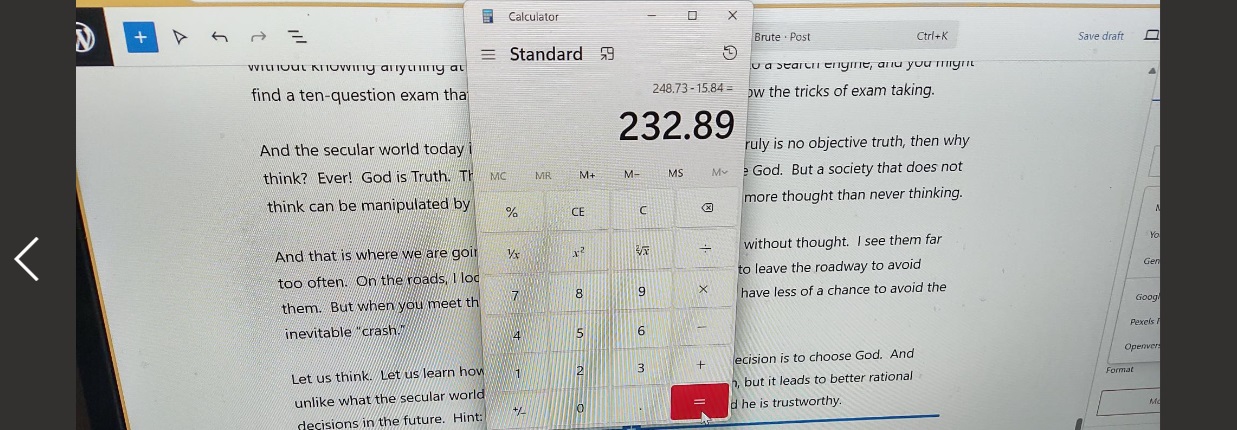
Okay, the photo above has a simple problem that might be in anyone’s checkbook. You have a balance of $248.73. You write a check for $15.84. Instead of solving the problem from right to left, like we were taught in grade school, subtract $16 from the balance. This gives you $232.73. But the check was 16 cents less than $16, and you add that back. You get $232.89 without having to carry any digit over or even writing it down. Oh, and dividing by five is done by multiplying the number by two and then moving the decimal point to the left by one position. Again, something you can do in your head. Rats! I missed out on another book deal!!!!
But in the first of Pascal’s thoughts, I wondered, “Was Pascal beaten up in the playground as he was growing up?” The person who does not have thought is a bully if he moves around, thus, in Pascal’s lexicon – the brute. But if the person without thought sits in the corner of the playground and stares at the grass, in Pascal’s lexicon – he’s the stone.
We have a lot of near brutes and near stones out there. I fear we have brutes and stones, but I give some credit, maybe a few, that the one marble in their brain might trigger a rare thought now and then.
And our school systems, that teach taking a standardized test, teach facts and memorization more than thought. Thought might create answer “F” among the standardized test answers of “A” through “E”. We are not inventing less new things these days because all the cool stuff has already been invented. We are teaching people how to follow instructions and choose between multiple choice answers – most of which require no thought, just memory. Inventing requires thought.
And knowing how to find a poorly written exam question means you can get an occasional answer without knowing anything at all. For example, type “fribbled breg” into a search engine, and you might find a ten-question exam that is nothing but gibberish, unless you know the tricks of exam taking.
And the secular world today is promoting a lack of thought. If there truly is no objective truth, then why think? Ever! God is Truth. That is the secular world’s aim, to eliminate God. But a society that does not think can be manipulated by a brute who rarely thinks, but still that is more thought than never thinking.
And that is where we are going. Unlike Pascal, I can imagine a person without thought. I see them far too often. On the roads, I look to see strong shoulders in case I have to leave the roadway to avoid them. But when you meet them in the workplace or in the home, you have less of a chance to avoid the inevitable “crash.”
Let us think. Let us learn how to make good decisions, and the best decision is to choose God. And unlike what the secular world says, choosing God is a spiritual decision, but it leads to better rational decisions in the future. Hint: God helps us make better decisions. And he is trustworthy.
Soli Deo Gloria. Only to God be the Glory.
 Thoughts from Mark "Hat" Rackley
Leave a comment