Religion that God our Father accepts as pure and faultless is this: to look after orphans and widows in their distress and to keep oneself from being polluted by the world.
- 2 Corinthians 9:6-8
They drive away the orphan’s donkey and take the widow’s ox in pledge.
- Job 24:3
He defends the cause of the fatherless and the widow, and loves the foreigner residing among you, giving them food and clothing.
- Deuteronomy 10:16
Count off seven weeks from the time you begin to put the sickle to the standing grain. Then celebrate the Festival of Weeks to the Lord your God by giving a freewill offering in proportion to the blessings the Lord your God has given you. And rejoice before the Lord your God at the place he will choose as a dwelling for his Name—you, your sons and daughters, your male and female servants, the Levites in your towns, and the foreigners, the fatherless and the widows living among you. Remember that you were slaves in Egypt, and follow carefully these decrees.
- Deuteronomy 16:9-12
As for younger widows, do not put them on such a list. For when their sensual desires overcome their dedication to Christ, they want to marry.
- 1 Timothy 5:11
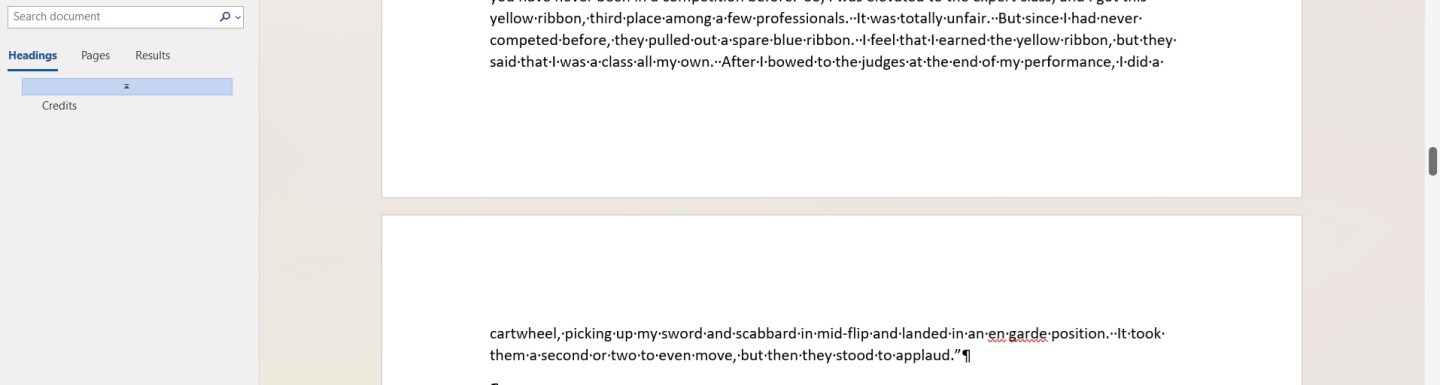
Note: In the image above, the two lines that slip to the beginning of the next page would be an “orphan” in type-setting terms if two lines were considered an orphan. Thus, more line would slip to the next page to protect the “orphan.” And this text is part of short story due to be published on this site later this month.
God has a heart for widows and orphans, but look at this from a cultural standpoint. In the days that these verses were written, women had few rights. Lydia, the seller of purple in Philippi, was a rare woman who had her own business. Thus, widows might be considered used up, worthless, a burden to those around them. The same could be said for children who are orphans or in the Old Testament vernacular, fatherless. Again, the fatherless label refers to a child who might have a mother, but that mother is a widow and that puts the fatherless child in a big bind also.
Note that Paul gives Timothy instruction on how to deal with the widows, and he even says that young widows should not be placed on the care list. Why? They can find another husband. And if you get offended by that remark, they can get another job.
There were problems within the culture of biblical times, but have women, on the whole, improved their position by the Women’s Lib movement? There are more women CEOs, but is the pay equal across the board? On average in the USA, women are paid 17% less than a man doing the same work, according to recent studies.
But why not widowers? In those times, men were expected to work. “Retire” is only mentioned once in the Bible, and that was for the people carrying the tents and such for the tabernacle (also tasked to set up and tear down). They could retire from the heavy lifting, but then become supervisors. In other words, no one ever quit working until the day they died.
But, I am a widower. And in a technical way, I lost both of my parents about fifteen years ago, within three months of each other, actually more like two and a half months. Thus, in a technical sense, I am an orphan.
But if we remove the labels, even the silly ones that I just mentioned, God is looking out for the least of these, whoever the “these” pertains to, and we should also.
But in my silly way, I was thinking of something completely different when I wrote this title. In the type setting business, or desktop publishing business, there is a term for widows and orphans.
In MSWord, you might be near the bottom of a page and you type a new paragraph. The first line stays on the old page, then when you continue typing, both lines jump to the next page. This might happen irritatingly where there are four jumps as you continue to type.
That is due to the widow-orphan rule. A paragraph that has one line on one page and then multiple lines on the next page is said to have a widow on the old page. And a paragraph that has all but the last line on the old page, but then puts the last line on the new page, that last line is considered an orphan.
But then, how do you define a widow or an orphan? If you define that two lines of text, or three lines, is no longer a widow or orphan, then if you start typing the third line (thinking of two lines not being a widow), the word processor will keep the two lines on one page and the remaining lines on the next page, unless the orphan rule is violated. If the orphan is no longer an orphan at two lines, then the word processor will put a three-line paragraph on the next page, but a four-line paragraph would be two lines on the bottom of one page and the other two on the top of the next, if it fits. Since one line is defined as a widow or orphan, two lines on each page is fine.
Thus, you see the flip from one page to the next to protect the widow, but then it flips back to protect the orphan.
You see, even soulless word processors are programmed to protect widows and orphans.
If you have widows and orphans in your family or your church family, they might appreciate a call.
Soli Deo Gloria. Only to God be the Glory.
 Thoughts from Mark "Hat" Rackley
Leave a comment