But one of his disciples, Judas Iscariot, who was later to betray him, objected, “Why wasn’t this perfume sold and the money given to the poor? It was worth a year’s wages.” He did not say this because he cared about the poor but because he was a thief; as keeper of the money bag, he used to help himself to what was put into it.
“Leave her alone,” Jesus replied. “It was intended that she should save this perfume for the day of my burial. You will always have the poor among you, but you will not always have me.”
Meanwhile a large crowd of Jews found out that Jesus was there and came, not only because of him but also to see Lazarus, whom he had raised from the dead. So the chief priests made plans to kill Lazarus as well, for on account of him many of the Jews were going over to Jesus and believing in him.
- John 12:4-11
“It will not bother me in the hour of death to reflect that I have been ‘had for a sucker’ by any number of imposters; but it would be a torment to know that one had refused even one person in need”
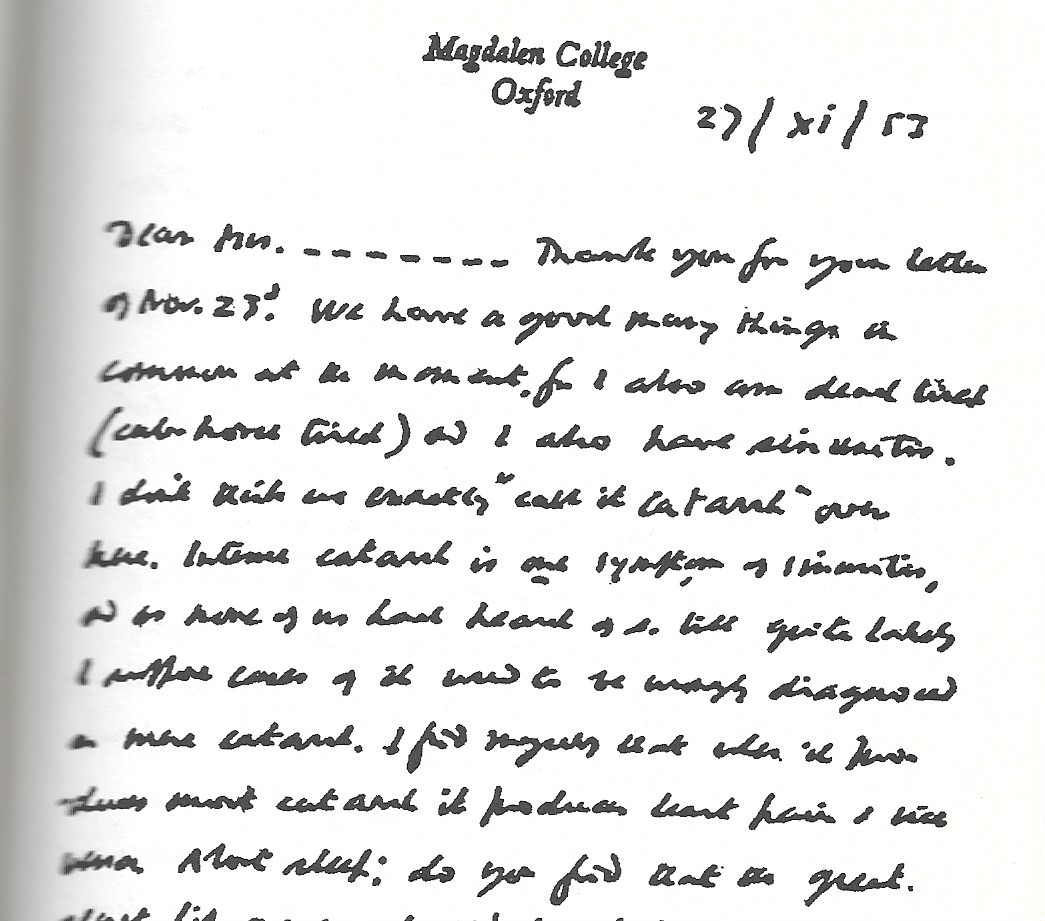
- C.S. Lewis, Letters to an American Lady (26 October 1962)
This is between the anniversary of the passing of C.S. Lewis and his birthday. He passed away one week before his birthday. This ends this mini-series on C.S. Lewis’ ideas about giving. From the date of the letter, the same letter as the quote on Tuesday’s installment, is about a year before he passed away.
So, he was probably thinking about the torment if he had refused someone in need. While his secretary may have put pen to paper, it was C.S. Lewis that insisted every letter he received got an answer. In that respect, he felt that if someone wrote him a letter, they had a need of some kind, and he needed to take the time to answer that need. And most of these letters to an American Lady were in the hand of C.S. Lewis personally.
But when you arrive at a hotel in downtown Mumbai, there are far more beggars than the money in your pockets. In the USA, when passing by the corners where panhandlers usually have a sign about unemployed and hungry, you cannot give to them all, and you will make the drivers angry if you miss the traffic light.
And Jesus says in the story above that we will always have the poor… Of course, He is emphasizing that He will go back to the Father after His death and resurrection, none of which Judas Iscariot saw, but we still have the poor today.
And we will always have the poor, so why do we torment ourselves as C.S. Lewis suggests? There will always be more poor people that we were unable to help. And does five dollars really help that panhandler? Yes, it adds up over the course of the day…
It’s like the story of the two friends walking down the beach, and one stoops down and picks up every sand dollar that he finds that has washed up onto shore. He throws each of them back into the sea. His friend says, “Why are you doing that? Every wave brings sand dollars toward the shore. You cannot save them all. It makes no difference in the grand scheme of things.” Then his friend picks up another sand dollar and tosses it back into the ocean. And he says as the sand dollar goes flying, “It makes a difference to that one.”
Soli Deo Gloria. Only to God be the Glory.
 Thoughts from Mark "Hat" Rackley
Leave a comment