“Anyone with such a defiling disease must wear torn clothes, let their hair be unkempt, cover the lower part of their face and cry out, ‘Unclean! Unclean! As long as they have the disease they remain unclean. They must live alone; they must live outside the camp.
- Leviticus 13:45-46
Now on his way to Jerusalem, Jesus traveled along the border between Samaria and Galilee. As he was going into a village, ten men who had leprosy met him. They stood at a distance and called out in a loud voice, “Jesus, Master, have pity on us!”
When he saw them, he said, “Go, show yourselves to the priests.” And as they went, they were cleansed.
One of them, when he saw he was healed, came back, praising God in a loud voice. He threw himself at Jesus’ feet and thanked him—and he was a Samaritan.
Jesus asked, “Were not all ten cleansed? Where are the other nine? Has no one returned to give praise to God except this foreigner?” Then he said to him, “Rise and go; your faith has made you well.”
- Luke 17:11-19
“Now the Passover and the Festival of Unleavened Bread were only two days away, and the chief priests and the teachers of the law were scheming to arrest Jesus secretly and kill him. “But not during the festival,” they said, “or the people may riot.”
While he was in Bethany, reclining at the table in the home of Simon the Leper, a woman came with an alabaster jar of very expensive perfume, made of pure nard. She broke the jar and poured the perfume on his head.
- Mark 14:1-3
The poor you will always have with you, and you can help them any time you want. But you will not always have me.
- Mark 14:7
“This is how the Lord granted me. brother Francis, to begin to do penance. While l was in sin, it seemed to me too bitter a thing to see lepers, but the Lord led me among them and l showed mercy to them. And when l left them, what had appeared to me bitter was changed into sweetness of body and soul. Not long after this l forsook the world … When the Lord had given me the care of the brethren, no one showed me what l ought to do — but the Most High himself revealed to me that l should live according to the form of the holy gospel. This l had written down in a few simple words and our lord the pope confirmed it for me. Those who came to embrace this life gave all they had to the poor. … As the Lord gave me to speak and write the Rule and these words, purely and simply, so you must understand them simply and purely, without gloss, and doing good, keep them to the end. (Testament).”
- Tony Lane, A Concise History of Christian Thought
St. Francis of Assisi (1181-1226) started the Franciscan order. In his Rule, he establishes the basic concept of the order. Give your worldly possessions to the poor and live a humble life.
Yet, in this testimony, St. Francis speaks of looking down on lepers, and then finding sweetness of body and soul in their midst.
My wife, when very young, went to the market with her babu in Indonesia. She saw the beggar playing the flute with his nose, since the soft tissue around his mouth was damaged by leprosy. She had no fear of the beggar and wanted a closer look, but the babu pulled her away.
We see in the Levitical Law that leprosy carried with it the problem of being unclean. These people were cast outside the assembly of the clean people. This was done to prevent rapid spread of the disease. We have better knowledge of these diseases today and better medical treatment, but the isolation is necessary in many cases.
Yet, there are many reasons why people are cast out of one level or another in our society. While the emphasis in the secular culture is skin color and gender identification, the age-old society outcasts have been the poor and no one today wants to talk about that. They have no voice, regardless of skin color or gender. And sadly, they never have. They may have a champion from one time to another, but as Jesus said, “We will always have the poor.”
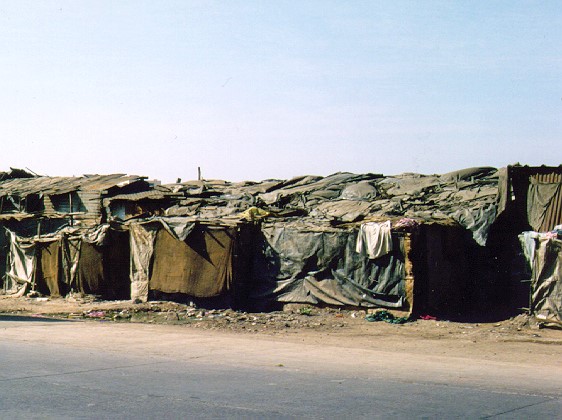
Should we always have the poor? The photo above is of the slums north of Mumbai, India. Indira Ghandhi built concrete high rises across from the slums, but these poor people only knew life in a canvas jungle. They rented out their apartments and moved back under the canvas. I heard a missionary from Brazil who visited homeless people who had been given government furnished apartments. They used the toilet as a flowerpot and then did their business in the backyard. They had no idea what modern plumbing was. I heard a similar argument on India talk radio, arguing that indoor plumbing left the house stinking, so they preferred to go outside.
I mention these culture shock moments to illustrate that just simply transferring a class of people into a different environment does not work very well. We truly have a portion of every society that is outside our group. St. Francis found that in a leper colony. I tipped a wait staff in India about one tenth what I would tip them in the USA. After one week, they had more money than they would ever see in a year, and the wait staff all quit. They were satisfied. I learned from this that the divide in economic class means more than a little extra money. For the next three weeks, the hotel manager stood over my shoulder (why when they had 10-12 of us over there on the project, why did I become the tipper?) and I withdrew a tiny amount that she approved. When I ran out of small bills, she made change for me. And I am talking bills equivalent to less than one dollar US, for serving food to 10-12 people.
The key with St. Francis is that he lived with them. I talked to a pastor one time. I saw three Americans going to an underdeveloped country. One was a tourist who only saw the bright and shiny places of the country. One was a missionary and only saw the mission and the people that mission helped. The third was the worker who was there to help the local workers improve the way they did things, which improved the quality of life. If the tourist wished, all three could do something for someone, but if you limit yourself to those of equal socio-economic status to yourself, you stay on the inside. It is when you spend extended time working with those and dining with those on the outside, that you really understand them better, and even then, not fully.
As St. Francis confessed, without the love of God within him, those on the outside seemed untouchable, but with the love of God inside us, we can go outside and find people who have sweetness of body and soul.
If you like these Tuesday morning essays about philosophy and other “heavy topics,” but you think you missed a few, you can use this LINK. I have set up a page off the home page for links to these Tuesday morning posts. I will continue to modify the page as I add more.
Soli Deo Gloria. Only to God be the Glory.


Thanks for sharing this idea. Anita
LikeLiked by 1 person
You’re welcome. Thanks for your comments.
LikeLike
Did you take that picture?
LikeLiked by 1 person
Yes. This is a small part of the sea of canvas at the Mumbai slums north of the city, basically the border between Mumbai and Navi Mumbai. There are high rise apartments in the opposite direction of the this photo, built by Indira Ghandi for these people, but they prefer their slums, so they rent their apartments to others, The rotten egg smell is horrible, but these people dumpster dive for things they can fix and resell. I was not fast enough with the camera to take a picture of a mountain of thousands of cigarette lighters, awaiting being refilled.
LikeLiked by 1 person
Wow; I feel with India there are sense of smells no picture can ever capture
LikeLiked by 1 person
You are so right, and the problem is that after a month being there, you smell that way on the return flight.
LikeLiked by 1 person
lol yes
LikeLike
And I pray you have your outlines finished.
LikeLiked by 1 person
Aww TY!
LikeLike