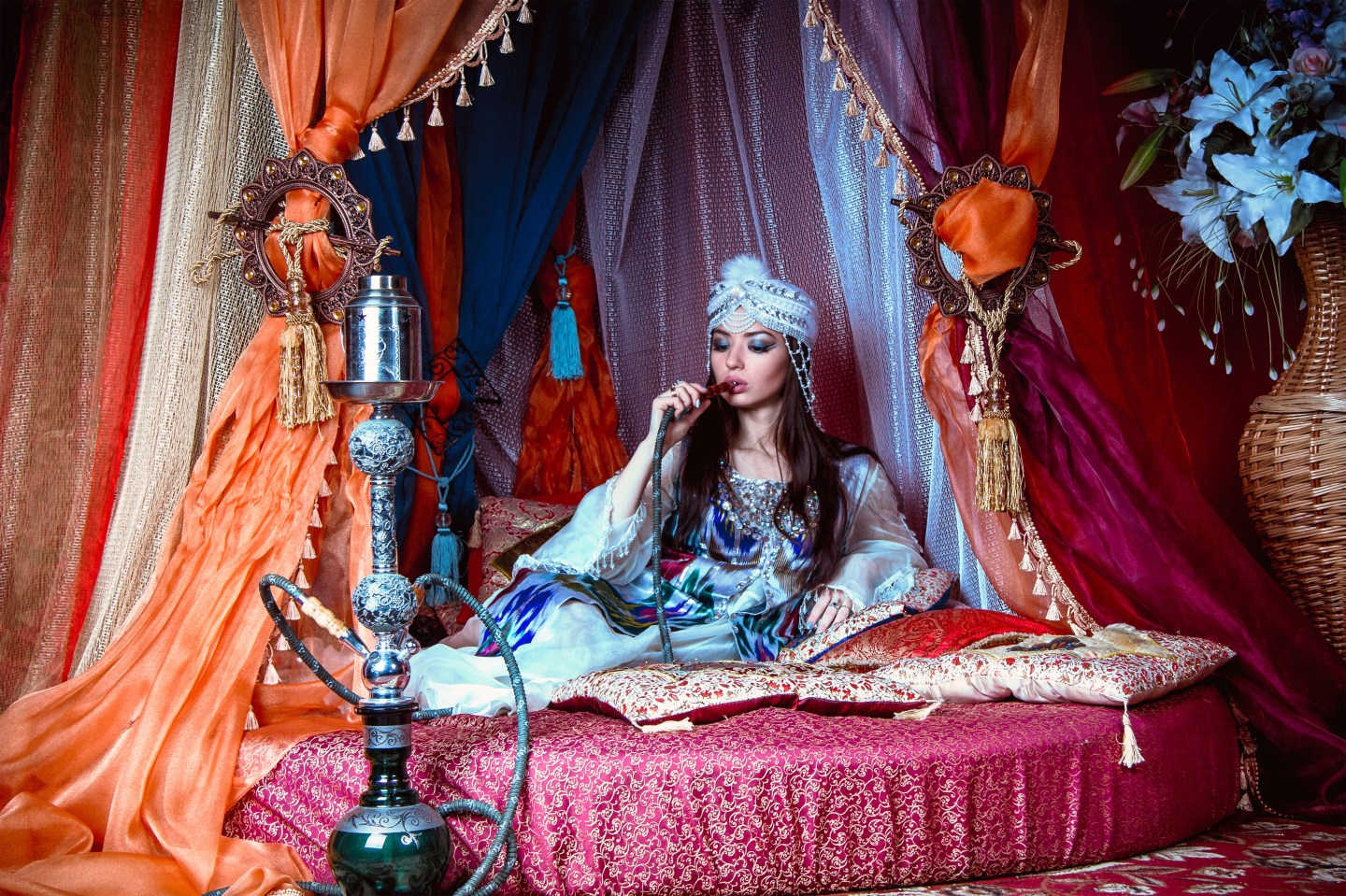
This is what happened during the time of Xerxes, the Xerxes who ruled over 127 provinces stretching from India to Cush: At that time King Xerxes reigned from his royal throne in the citadel of Susa, and in the third year of his reign he gave a banquet for all his nobles and officials. The military leaders of Persia and Media, the princes, and the nobles of the provinces were present.
For a full 180 days he displayed the vast wealth of his kingdom and the splendor and glory of his majesty. When these days were over, the king gave a banquet, lasting seven days, in the enclosed garden of the king’s palace, for all the people from the least to the greatest who were in the citadel of Susa. The garden had hangings of white and blue linen, fastened with cords of white linen and purple material to silver rings on marble pillars. There were couches of gold and silver on a mosaic pavement of porphyry, marble, mother-of-pearl and other costly stones. Wine was served in goblets of gold, each one different from the other, and the royal wine was abundant, in keeping with the king’s liberality. By the king’s command each guest was allowed to drink with no restrictions, for the king instructed all the wine stewards to serve each man what he wished.
Queen Vashti also gave a banquet for the women in the royal palace of King Xerxes.
On the seventh day, when King Xerxes was in high spirits from wine, he commanded the seven eunuchs who served him—Mehuman, Biztha, Harbona, Bigtha, Abagtha, Zethar and Karkas—to bring before him Queen Vashti, wearing her royal crown, in order to display her beauty to the people and nobles, for she was lovely to look at. But when the attendants delivered the king’s command, Queen Vashti refused to come. Then the king became furious and burned with anger.
Since it was customary for the king to consult experts in matters of law and justice, he spoke with the wise men who understood the times and were closest to the king—Karshena, Shethar, Admatha, Tarshish, Meres, Marsena and Memukan, the seven nobles of Persia and Media who had special access to the king and were highest in the kingdom.
“According to law, what must be done to Queen Vashti?” he asked. “She has not obeyed the command of King Xerxes that the eunuchs have taken to her.”
Then Memukan replied in the presence of the king and the nobles, “Queen Vashti has done wrong, not only against the king but also against all the nobles and the peoples of all the provinces of King Xerxes. For the queen’s conduct will become known to all the women, and so they will despise their husbands and say, ‘King Xerxes commanded Queen Vashti to be brought before him, but she would not come.’ This very day the Persian and Median women of the nobility who have heard about the queen’s conduct will respond to all the king’s nobles in the same way. There will be no end of disrespect and discord.
“Therefore, if it pleases the king, let him issue a royal decree and let it be written in the laws of Persia and Media, which cannot be repealed, that Vashti is never again to enter the presence of King Xerxes. Also let the king give her royal position to someone else who is better than she. Then when the king’s edict is proclaimed throughout all his vast realm, all the women will respect their husbands, from the least to the greatest.”
The king and his nobles were pleased with this advice, so the king did as Memukan proposed. He sent dispatches to all parts of the kingdom, to each province in its own script and to each people in their own language, proclaiming that every man should be ruler over his own household, using his native tongue.
- Esther 1:1-22
Later when King Xerxes’ fury had subsided, he remembered Vashti and what she had done and what he had decreed about her. Then the king’s personal attendants proposed, “Let a search be made for beautiful young virgins for the king. Let the king appoint commissioners in every province of his realm to bring all these beautiful young women into the harem at the citadel of Susa. Let them be placed under the care of Hegai, the king’s eunuch, who is in charge of the women; and let beauty treatments be given to them. Then let the young woman who pleases the king be queen instead of Vashti.” This advice appealed to the king, and he followed it.
Now there was in the citadel of Susa a Jew of the tribe of Benjamin, named Mordecai son of Jair, the son of Shimei, the son of Kish, who had been carried into exile from Jerusalem by Nebuchadnezzar king of Babylon, among those taken captive with Jehoiachin king of Judah. Mordecai had a cousin named Hadassah, whom he had brought up because she had neither father nor mother. This young woman, who was also known as Esther, had a lovely figure and was beautiful. Mordecai had taken her as his own daughter when her father and mother died.
When the king’s order and edict had been proclaimed, many young women were brought to the citadel of Susa and put under the care of Hegai. Esther also was taken to the king’s palace and entrusted to Hegai, who had charge of the harem. She pleased him and won his favor. Immediately he provided her with her beauty treatments and special food. He assigned to her seven female attendants selected from the king’s palace and moved her and her attendants into the best place in the harem.
Esther had not revealed her nationality and family background, because Mordecai had forbidden her to do so. Every day he walked back and forth near the courtyard of the harem to find out how Esther was and what was happening to her.
Before a young woman’s turn came to go in to King Xerxes, she had to complete twelve months of beauty treatments prescribed for the women, six months with oil of myrrh and six with perfumes and cosmetics. And this is how she would go to the king: Anything she wanted was given her to take with her from the harem to the king’s palace. In the evening she would go there and in the morning return to another part of the harem to the care of Shaashgaz, the king’s eunuch who was in charge of the concubines. She would not return to the king unless he was pleased with her and summoned her by name.
When the turn came for Esther (the young woman Mordecai had adopted, the daughter of his uncle Abihail) to go to the king, she asked for nothing other than what Hegai, the king’s eunuch who was in charge of the harem, suggested. And Esther won the favor of everyone who saw her. She was taken to King Xerxes in the royal residence in the tenth month, the month of Tebeth, in the seventh year of his reign.
Now the king was attracted to Esther more than to any of the other women, and she won his favor and approval more than any of the other virgins. So he set a royal crown on her head and made her queen instead of Vashti. And the king gave a great banquet, Esther’s banquet, for all his nobles and officials. He proclaimed a holiday throughout the provinces and distributed gifts with royal liberality.
When the virgins were assembled a second time, Mordecai was sitting at the king’s gate. But Esther had kept secret her family background and nationality just as Mordecai had told her to do, for she continued to follow Mordecai’s instructions as she had done when he was bringing her up.
During the time Mordecai was sitting at the king’s gate, Bigthana and Teresh, two of the king’s officers who guarded the doorway, became angry and conspired to assassinate King Xerxes. But Mordecai found out about the plot and told Queen Esther, who in turn reported it to the king, giving credit to Mordecai. And when the report was investigated and found to be true, the two officials were impaled on poles. All this was recorded in the book of the annals in the presence of the king.
- Esther 2:1-23
After these events, King Xerxes honored Haman son of Hammedatha, the Agagite, elevating him and giving him a seat of honor higher than that of all the other nobles. All the royal officials at the king’s gate knelt down and paid honor to Haman, for the king had commanded this concerning him. But Mordecai would not kneel down or pay him honor.
Then the royal officials at the king’s gate asked Mordecai, “Why do you disobey the king’s command?” Day after day they spoke to him but he refused to comply. Therefore they told Haman about it to see whether Mordecai’s behavior would be tolerated, for he had told them he was a Jew.
When Haman saw that Mordecai would not kneel down or pay him honor, he was enraged. Yet having learned who Mordecai’s people were, he scorned the idea of killing only Mordecai. Instead Haman looked for a way to destroy all Mordecai’s people, the Jews, throughout the whole kingdom of Xerxes.
In the twelfth year of King Xerxes, in the first month, the month of Nisan, the pur (that is, the lot) was cast in the presence of Haman to select a day and month. And the lot fell on the twelfth month, the month of Adar.
Then Haman said to King Xerxes, “There is a certain people dispersed among the peoples in all the provinces of your kingdom who keep themselves separate. Their customs are different from those of all other people, and they do not obey the king’s laws; it is not in the king’s best interest to tolerate them. If it pleases the king, let a decree be issued to destroy them, and I will give ten thousand talents of silver to the king’s administrators for the royal treasury.”
So the king took his signet ring from his finger and gave it to Haman son of Hammedatha, the Agagite, the enemy of the Jews. “Keep the money,” the king said to Haman, “and do with the people as you please.”
Then on the thirteenth day of the first month the royal secretaries were summoned. They wrote out in the script of each province and in the language of each people all Haman’s orders to the king’s satraps, the governors of the various provinces and the nobles of the various peoples. These were written in the name of King Xerxes himself and sealed with his own ring. Dispatches were sent by couriers to all the king’s provinces with the order to destroy, kill and annihilate all the Jews—young and old, women and children—on a single day, the thirteenth day of the twelfth month, the month of Adar, and to plunder their goods. A copy of the text of the edict was to be issued as law in every province and made known to the people of every nationality so they would be ready for that day.
The couriers went out, spurred on by the king’s command, and the edict was issued in the citadel of Susa. The king and Haman sat down to drink, but the city of Susa was bewildered.
- Esther 3:1-15
Noted Biblical Scholars, Teachers, and Preachers Comments
Esther 1:1 ‘Ahasuerus’: “… The kingdom comprised twenty regions (3:12; 8:9; 9:3) which were further divided into provinces ruled over by governors (3:12). India to Ethiopia. Ethiopia, not Asia Minor, is mentioned as representing the western edge of the kingdom to avoid any remembrance of the king’s previous defeat by the Greeks c. 481-479 B.C. (cf. 8:9). This description also avoided any confusion with the Ahasuerus of Daniel 9:1.”
- John MacArthur, John MacArthur Commentary (quoted Scripture without bold/italics)
Esther 1:2 ‘Shushan the citadel’: “Shushan (the Hebrew rendering of the Greek Susa), the winter residence, was one of four capital cities of the Persians; the other three included Babylon, Ecbatana (Ezra 6:2), and Persepolis. The citadel refers to the fortified palace complex built above the city for protection.”
- John MacArthur, John MacArthur Commentary (quoted Scripture without bold/italics)
Esther 1:9 ‘Queen Vashti’: “Greek literature records her name as Amestris. She gave birth (c. 483 B.C.) to Ahasuerus’s third son, Artaxerxes, who later succeeded his father Ahasuerus on the throne (Ezra 7:1).”
- John MacArthur, John MacArthur Commentary (quoted Scripture without bold/italics)
Esther 1:12 ‘Vashti refused’: “Her reason is not recorded, although suggestions have included that (1) her appearance would have involved lewd behavior before drunken men, or (2) that she was still pregnant with Artaxerxes.”
- John MacArthur, John MacArthur Commentary (quoted Scripture without bold/italics)
Esther 1 ‘comparison of Vashti with the Fall of Man’: ”When we meet the king in the book of Esther, we see that he has nothing to do but throw a lavish party to display the glory of his kingdom. In the same way, Adam and Eve, our forebears, had nothing to do but display the glory of God and to rule over the earth. In the book of Esther, the prideful king summons Queen Vashti to display her before his drunken cronies.
“This scene parallels the account of the fall of man, when people chose to assert their own wills against God’s revealed will. In the palace of the human spirit, symbolized by Queen Vashti, the God of glory and truth lived. It was there that the human mind, emotions, and will were guided by fellowship with the living Lord, who dwelt in the royal residence of the human spirit. God explained His will to the first two members of the human race, Adam and Eve. If they would simply be obedient to His revealed will, they would fulfill their God-given destiny and utilize the full powers of their unfallen humanity as God originally intended. Tragically, they set their will and reason above God’s will and revelation. With this human choice came the fall.
“The fall, the beginning of humanity’s woes, is symbolized for us in the opening chapters of Esther, when the king issues a decree that Queen Vashti be deposed from the throne. Once issued, a decree became law of the Medes and Persians; the king could do nothing to reverse it, even though he would later regret the decree when he was sober.
In his loneliness, he searches for a new queen. …”
- Ray C. Stedman, Adventuring Through the Bible
Esther 2:1 ‘After these things’: “Most likely during the latter portion of the king’s ill-fated war with Greece (c. 481-479 B.c.). he remembered Vashti. The king was legally unable to restore Vashti (cf. 1:19-22), so the counselors proposed a new plan with promise.”
- John MacArthur, John MacArthur Commentary (quoted Scripture without bold/italics)
Esther 2:5 ‘Mordecai’: “… He was among the fourth generation of deported Jews. Kish. Mordecai’s great grandfather who actually experienced the Babylonian deportation. After Babylon fell to Medo-Persia (c. 539 B.C.), Jews were moved to other parts of the new kingdom. Kish represents a Benjamite family name that could be traced back (c. 1100 B.C.) to Saul’s father (1 Sam. 9:1).”
- John MacArthur, John MacArthur Commentary (quoted Scripture without bold/italics)
Esther 2:6 ‘Jeconiah’: “Former king of Judah (also known as Jehoiachin and Coniah) who was deported c. 597 B.C. (cf. 2 Kin. 24:14, 15; 2 Chr. 36:9, 10). Due to his disobedience, the Lord removed his descendants from the line of David to Christ (Jer. 22:24-30). The family of Mordecai and Esther were part of the good figs in Jeremiah 24:1—7.”
- John MacArthur, John MacArthur Commentary (quoted Scripture without bold/italics)
Esther 2:8-9 ‘Esther also taken’: “It is impossible to tell if Esther went voluntarily or against her will. That she pleased Hegai points to God’s providential control.”
- John MacArthur, John MacArthur Commentary (quoted Scripture without bold/italics)
Esther 2:17 ‘Esther chosen’: ”King Xerxes chooses her to be his queen. So Esther is exalted from a place of bondage to the second most honored position in the kingdom. On Mordecai’s advice, Esther does not tell the king that she is Jewish. (The king’s ignorance of this fact will later become a key detail in the story.)
“The marriage between King Xerxes and Queen Esther is a symbolic picture of conversion. In essence, the king receives a new spirit (the queen), even though he has no awareness of Mordecai (who represents the Holy Spirit). The king symbolizes those Christians who have little or no understanding of what has happened to them the moment they received Christ.”
- Ray C. Stedman, Adventuring Through the Bible
Esther 2:23 ‘hanged on the gallows’: “The Persian execution consisted of being impaled (cf. Ezra 6:11). It is likely that they were the originators of crucifixion. book of the chronicles. The king would five years later (Ahasuerus’s twelfth year) read these Persian records as the turning point in Esther (6:1, 2).”
- John MacArthur, John MacArthur Commentary (quoted Scripture without bold/italics)
Esther 3:2 ‘would not bow’: “There is a question as to whether Esther and Mordecai were inclined to obey the Mosaic Law. This refusal may be more likely grounded in the family feud between the Benjamites and the Agagites …, than Mordecai’s allegiance to the second Commandment (Ex. 20:4-6).”
- John MacArthur, John MacArthur Commentary (quoted Scripture without bold/italics)
Esther 3:4 ‘he was a Jew’: “It seems evident, from Haman’s fury and attempted genocide, that there were strong anti-Semitic attitudes in Shushan, which seems to explain Mordecai’s reluctance to reveal his true ethnic background.”
- John MacArthur, John MacArthur Commentary (quoted Scripture without bold/italics)
Esther 3:5 ‘the gallows meant for the good man hangs the builder’: “In the days of Esther the evil Haman listened to the blandishments of Satan and set out to try to destroy the Jews. The outcome revealed how very unwise the effort had been. The Jews went free and Haman swung from the very gallows he had erected for his hated enemy, the Jew Mordecai. When the body of Haman swung back and forth on the gallows he had built for another, the folly of unrighteousness was exposed in a way and to a degree that must have surprised Satan. The world now knows, or can know if it will, that every gallows built to destroy good men will hang the builder at last. Justice may be a long time getting around to it, but evil will hang finally. Satan did not know this, or if he did he never intended that the secret should get out; either way his supposed shrewdness failed him.“
- A. W. Tozer, The Warfare of the Spirit
Esther 3:6 ‘the people of Mordecai’: “Haman was being satanically used to target the entire Jewish race in an unsuccessful attempt to change the course of redemptive history and God’s plans for Israel.”
- John MacArthur, John MacArthur Commentary (quoted Scripture without bold/italics)
Esther 3:8 ‘Haman’s hatred of the Jews’: ”Haman rises to a place of prominence, subordinate in power only to the king. He is called a ‘captain of princes,’ and his position is much like the one Joseph held under the Egyptian pharaoh, somewhat like a prime minister. When Haman learns that Mordecai refuses to bow the knee and pay honor to him, he becomes enraged. Learning that Mordecai is a Jew, he vows to eliminate Mordecai from the kingdom. Moreover, to repay Mordecai for his insult, Haman hatches a Hitlerian plan ‘to destroy, kill and annihilate all the Jews.’
“Throughout this account we read how Haman is consumed by his hatred of the Jews. Why does he hate this race so much? The text gives us a clue.”
- Ray C. Stedman, Adventuring Through the Bible
Esther 3:13 ‘to destroy’: “An ambitious plot to annihilate the Jews in just one day. Historians have calculated the date to be March 7, 473 B.C. The king had unwittingly approved this provision which would kill his own queen.”
- John MacArthur, John MacArthur Commentary (quoted Scripture without bold/italics)
My Thoughts
This story starts with King Xerxes when he ruled over 127 provinces from Cush to India. Cyrus the Great was two, or three, rulers before him. Thus, the first remnant of Jews had returned with Zerubbabel. The next group with Ezra and the third with Nehemiah would follow. As pointed out in the MacArthur Commentary, Vashti was the mother of Artaxerxes who sent Ezra and Nehemiah. It is unclear if she was pregnant at the time of this incident. But I tend to believe she had already given birth. This puts a third proposed reason for not appearing before her husband, but I get ahead of myself.
Xerxes was having a half-year-long celebration. It could be the pregnancy of Vashti and the impending birth of Artaxerxes, not knowing if Vashti was really pregnant at first, thus six months and the birth, but that is just my thought. The purpose of this celebration is not mentioned, but the maps of conquest that I have found do not have any additions to the conquests after Darius I, Xerxes father. And the maps also show the eastern extent of the Persian Empire to barely touch India, maybe not touching India. The extent went past the Indus River which is in Pakistan (once a part of India). Since this was the third year of his reign, a coronation celebration was not the reason either.
Also on the western front, Cush is equated by most scholars with Ethiopia, but if you took the Persian Empire conquests and overlay that on a modern map, the Persian Empire would reach eastern Sudan and maybe a little bit of Eritrea, never quite reaching what is left of modern Ethiopia. But then, the maps of the Persian Empire seem to disagree with each other. But stating from Cush (Ethiopia) to India is very close to those borders on today’s map. Note: Sorry, this was an engineer’s explanation, getting too technical, but some people might be interested (i.e. other engineers).
But after the 180 days of celebration, he hosted a banquet that lasted seven days. He put no limits on the drinking, so all involved, including Xerxes, were drunk as skunks (as the saying goes).
In the meantime, Vashti, the queen, is hosting her own banquet with the ladies. When she is summoned, she refuses. Rev. MacArthur suggests that she was possibly pregnant with Artaxerxes at the time or she did not wish to be molested by a crowd of drunk officials who felt themselves intitled. I could add, that if she had already delivered the baby, she may not have returned to her girlish figure, and she would not wish to expose that fact to her husband who idolized her. Was she a great belly dancer, but those muscles were not in shape after giving birth? Frankly, in discussing this in past Sunday school classes over the many years, not wanting to be molested by people who felt intitled and were also drunk seemed to be the census, but still that is a guess. She could have simply not wished to leave her lady-like party unattended.
But she had overstepped her authority as queen. Xerxes is embarrassed, and he turns to his advisors. Note: Xerxes is drunk. His advisors are drunk. But they make a cogent argument that if the king cannot control his “woman” then all the husbands in the land will be in danger. Misogynistic, but cogent.
Note here also that a decree from the king was binding and could not be rescinded, even if the king argued that he was drunk at the time. In discussing the oath made by Jephthah that led to the sacrifice of his daughter, I have read a variety of scathing rebukes by scholars, but an oath to the Israelites could be in the same realm as a decree by the Persian king. You would have Almighty God to deal with if you went “backsies” (slang for taking back or cancelling something you said before) on an oath or decree.
Oh, what a world we would live in if a politician had to tell the truth under penalty of death when he made campaign promises. Most promises that I hear on television commercials are 1) impossible to achieve and 2) the exact opposite of that party’s track record. But we live in a world where people make two major mistakes: 1) They believe the lies and 2) They trust the politician without trusting God. The bliss we would achieve for a short time would be that all politicians would be sent to death row. I do not know of a single politician that accomplished everything that he promised.
So, to maintain the patriarchal condition, Xerxes cans Vashti. She lives, but she is placed somewhere that the king can never see her again. Thus, she can raise Artaxerxes to be the next king, and maybe teach him to not make decrees while drunk.
And I am not saying that the patriarchal system should be abolished, but if the father in the unit is not loving, then his decrees will not be just. Note that while Paul says for women to obey their husbands, he demands that the husband love his wife, which carries some sort of give and take and communication for that to work. God’s laws, and even the suggestions, work if we obey them to the letter. But sin gets in the way.
But when Xerxes sobers up, he misses Vashti. His advisors are also sober, but they know he cannot go back on what he decreed. A beauty pageant, of sorts, becomes the solution. Whoever pleases the king will be the queen.
I like Rev. MacArthur’s idea that the verb is “take” meaning that we do not know if Hadassah (soon to be known as Esther) went willingly or was forced to go because she was pretty.
But on seeing her, the eunuch in charge of the virgins, Hegai, was pleased with Esther. Note, once the candidate for queen left the kings presence, they were given to a different eunuch, Shaashgaz, eunuch over the concubines. In other words, the other beautiful ladies, not selected as queen, became slaves in the harem, to be used as the king felt like using them. Hegai, liking Esther, put her in a preferred location, gave her preferred beauty treatments and food – a process lasting a year. Esther was instructed by her cousin Mordecai (or uncle, he was possibly the first cousin of Esther’s father, and he treated her as if she was his child upon Esther’s father’s death). Esther knew not to talk about her being a Jew. It never came up in conversation. Esther was wise. Instead of taking what she felt important to place before the king, she asked Hegai, and chose his gift when she went to the king. Hegai, outside the emotional attachments and anxiety associated with this one-time meeting, Hegai had worked there long enough to know what would please the king. Whether Hegai’s special treatment did the trick or whether Esther’s natural beauty was head and shoulders above the other ladies, the king was pleased with Esther. She was crowned queen, and a banquet was given.
There is a lot of detail given here on how Esther became queen. She pleased Hegai. Hegai gave her preferential treatment. She was wise enough to take Hegai’s selection of a gift to present the king. And the king was pleased. It never says that the Spirit of God came upon Hegai and/or Xerxes to find Esther pleasing. Nor does it say that the Spirit of God came upon Esther in being wise when it came to her choice of gift or how she behaved when with Xerxes. Scholars have noted a lack of the use of “God” in the book of Esther, but you can infer God’s sovereignty throughout the book.
But I also see the kernel of antisemitism at this point. Cyrus sent Zerubbabel back to Jerusalem to build the temple. This angered all the nations around Judah. Cyrus was doing God’s will, even though he did not worship God. He really had no choice, and once he decreed and the decree was written down, the decree had to be followed, whether everyone in his empire disagreed with the decree. So, you had the resistance during the time of Zerubbabel. There was a huge gap in the construction, a generation at least, and the old paperwork had to be dug out of the files to prove that the work was ordered by Cyrus the Great. So, the enemies of the Jews were doing every little trick they could do to prevent the return of the remnant. And while I gave credit to God for Esther becoming queen, antisemitism is from Satan. As pointed out in the scholarly quotes, if Haman had gotten his wishes, throughout the entire empire of Persia, there would be no bloodline from David to Jesus. It is obvious that this would be of prime importance to Satan.
But before we get to Haman, Mordecai overhears two of the king’s officers at the gate where he stayed to keep an eye on Esther. They were plotting to assassinate the king. Mordecai told Esther and Esther got the word to the king. The two conspirators were empaled. This was the preferred method of execution in Persia. I like Rev. MacArthur’s idea that morphing from empaling the criminal to the cross makes the death much more excruciating. Death by empaling is sudden. The cross uses roughly the same tool, a tree, and it takes much longer, with a lot more suffering. Mordecai is credited for thwarting the assassination attempt.
Now with Esther 3, Haman becomes second in command. He is an Agagite, who had a feud with the Jews already. Xerxes commands that all must bow to Haman, but Mordecai does not. Is this like the omission of God’s involvement in this story by the author or was the omission of Mordecai’s refusal to bow less than honorable, in other words, the feud. Most casual readers would eventually get around to reading the story of Shadrach, Meshach, and Abednego in the book of Daniel and draw the conclusion that Mordecai was following the Second Commandment. But the text never says.
But Haman becomes so obsessed in getting rid of Mordecai, he tricks the king into getting the ring, thus Haman can make a decree, and it looks like it came from Xerxes himself. The decree: on a day within that year, but later on, all people of Jewish descent were to be executed. Unlike Hitler, Haman wanted them all dead on the same day. He was pure evil, but there was a sense of poetry about him. Let’s make this genocide spectacular in that it happened all on one day. The problem is that Esther, the queen of the land was a Jew, and Haman did not know that. But, was it only antisemitism that fueled Haman? No. The decree called for every Jew’s belongings to be plundered. Hitler did the same thing, including stealing the gold crowns from the teeth of the gas chamber victims. At least, I have seen photographs of the buckets of gold fillings. I assume they were obtained postmortem.
They are using the chant “From the River to the Sea, Palestine will be free.” In other words, the chant is calling for genocide of the Jews. The same story for the past 2500 years, roughly. But what does God do each time? He saves a remnant of His Chosen People. They have already produced the Savior, Jesus Christ, but God still loves the Jews. He will protect them.
This is a Perils of Pauline moment. A cliffhanger that will hopefully get the reader to continue reading in the book of Esther or come back next week.
Some Serendipitous Reflections
Esther 1: 1. With which of the characters do you most identify? Why? Where in your life are you working on: (a) Obeying authority? (b) Mutual respect? (c) Sharing (not showing) your wealth? (d) Being the host with the most?
“2. For what grand occasion would you and yours co-host a gala affair: Your 40th birthday? Silver anniversary? Opening a new business? Graduation?
“3. What important decision is pending for you? What input from the group would you like for this?
“4. In decisions affecting other people, who is your ‘Memucan’? Who else would you feel free to call in the middle of the night?
“5. The nobles feared anarchy would result if women were as ‘independent’ as Vashti. At home, how are decisions made if you can’t agree or speak ‘the same language’?
Esther 2:1-18 Esther Made Queen 1. Where would you fit yourself into this story: A queen fit for a king? A runner-up? A personal attendant? A fretful, fatherly Mordecai?
“2. If you were one of these characters, what would be your best line? Role play this one, if you like.
“3. How important is physical attractiveness to you in courting or keeping your mate?
“4. How would you feel if God, as King, took four years to till a ‘vacancy’ or solve some other problem in your life? How important (to you and God) is ‘time’ and ‘timing’?
“5. If you were chosen queen (or king), what would be the greatest strength or asset you’d bring to your country? Where are you using that gift now?
Esther 2:19-23 Mordecai Uncovers a Conspiracy 1. Do you see coincidence or providence at work behind these scenes? How so?
“2. In your life, what do you see more of: Fate? Chance? Design? Destiny? Explain.
Esther 3: 1. As a fellow Jew, would you have urged Mordecai to ‘bow his knee’ rather than risk the lives of everyone else? Why?
“2. Think of some whose customs are different from yours. How does that affect your fellowship? Do you build on the similarities, or bridge the differences? Why?
“3. In conflicts of conscience, are you more like: (a) Mordecai, a pacifist protester? (b) Haman, an enraged politician? (c) Xerxes, easily swayed or pacified? (d) The couriers, dutifully bearing whatever news they are given? (e) The people, bewildered by it all?”
- Lyman Coleman, et al, The NIV Serendipity Bible for Study Groups
There is one set of questions each for Esther 1 and 3. Esther 2 is divided into two sets of questions.
In the suggestion of role playing, if you are doing this alone as a self-study, picture yourself in different roles, and ask how others in the story might react to your actions.
Substitute whatever group for any reference to a small group or ask who could come to your aid.
If you like these Thursday morning Bible studies, but you think you missed a few, you can use this LINK. I have set up a page off the home page for links to these Thursday morning posts. I will continue to modify the page as I add more.
Soli Deo Gloria. Only to God be the Glory.
 Thoughts from Mark "Hat" Rackley
This is an amazing Bible study, Mark. I wrote a play on the book of Esther several years ago and could’ve used so much of this history. Thanks for sharing.
LikeLiked by 1 person
It was a pleasure. I like figuring things out. And the timeline of Ezra. Nehemiah, and Esther had always been a mystery.
LikeLiked by 1 person
Esther is sooo fascinating
LikeLiked by 1 person
I agree. For a book that never mentions God, God is in everything.
LikeLiked by 1 person
True
LikeLiked by 1 person