Children, obey your parents in the Lord, for this is right. “Honor your father and mother”—which is the first commandment with a promise—“so that it may go well with you and that you may enjoy long life on the earth.”
Fathers, do not exasperate your children; instead, bring them up in the training and instruction of the Lord.
Slaves, obey your earthly masters with respect and fear, and with sincerity of heart, just as you would obey Christ. Obey them not only to win their favor when their eye is on you, but as slaves of Christ, doing the will of God from your heart. Serve wholeheartedly, as if you were serving the Lord, not people, because you know that the Lord will reward each one for whatever good they do, whether they are slave or free.
And masters, treat your slaves in the same way. Do not threaten them, since you know that he who is both their Master and yours is in heaven, and there is no favoritism with him.
Finally, be strong in the Lord and in his mighty power. Put on the full armor of God, so that you can take your stand against the devil’s schemes. For our struggle is not against flesh and blood, but against the rulers, against the authorities, against the powers of this dark world and against the spiritual forces of evil in the heavenly realms. Therefore put on the full armor of God, so that when the day of evil comes, you may be able to stand your ground, and after you have done everything, to stand. Stand firm then, with the belt of truth buckled around your waist, with the breastplate of righteousness in place, and with your feet fitted with the readiness that comes from the gospel of peace. In addition to all this, take up the shield of faith, with which you can extinguish all the flaming arrows of the evil one. Take the helmet of salvation and the sword of the Spirit, which is the word of God.
And pray in the Spirit on all occasions with all kinds of prayers and requests. With this in mind, be alert and always keep on praying for all the Lord’s people. Pray also for me, that whenever I speak, words may be given me so that I will fearlessly make known the mystery of the gospel, for which I am an ambassador in chains. Pray that I may declare it fearlessly, as I should.
Tychicus, the dear brother and faithful servant in the Lord, will tell you everything, so that you also may know how I am and what I am doing. I am sending him to you for this very purpose, that you may know how we are, and that he may encourage you.
Peace to the brothers and sisters, and love with faith from God the Father and the Lord Jesus Christ. Grace to all who love our Lord Jesus Christ with an undying love.
- Ephesians 6:1-24
Noted Biblical Scholars, Teachers, and Preachers Comments
Ephesians 6:1, 3-4 ‘parents and children’: “Paul takes both parents and children to task in these verses. ‘Parents’ (‘fathers’ in verse 4), he says, ‘don’t mistreat your children to make them angry, and children, honor your father and mother by obeying them.’
“Neither one of these directives seems easy at times. Our eldest daughter, Tiara, once said-borrowing from Mark Twain-that Lauren and I didn’t make much sense when she was a teenager, but once she got to college, everything we had told her started making sense. It’s funny, but since I’ve retired and have been spending more time at home, I can see both sides of the relationship more clearly.”
- Tony Dungy, Uncommon Life – Daily Challenge (excerpt from devotion for 16 October)
Ephesians 6:1 ‘obey … in the Lord’: “See Colossians 3:20. The child in the home is to be willingly under the authority of parents with obedient submission to them as the agents of the Lord placed over him, obeying parents as if obeying the Lord Himself. The reasoning here is simply that such is the way God has designed and required it (‘right’). Cf. Hosea 14:9.”
- John MacArthur, John MacArthur Commentary (quoted Scripture without bold/italics)
Ephesians 6:2-3 ‘honor’: “While verse 1 speaks of action, this term speaks of attitude, as Paul deals with the motive behind the action. When God gave His Law in the Ten Commandments, the first law governing human relationships was this one (Ex. 20:12; Deut. 5:16). It is the only command of the ten that relates to the family because that principle alone secures the family’s fulfillment. Cf. Exodus 21:15, 17; Leviticus 20:9; Matthew 15:3-6. Proverbs affirms this principle (see 1:8; 3:1; 4:1-4; 7:1-3; 10:1; 17:21; 19:13, 26; 28:24).”
- John MacArthur, John MacArthur Commentary (quoted Scripture without bold/italics)
Ephesians 6:4 ‘fathers’: “The word technically refers to male parents, but was also used of parents in general. Since Paul had been speaking of both parents (vv. 1-3), he probably had both in mind here. The same word is used in Hebrews 11:23 for Moses’ parents. do not provoke. In the pagan world of Paul’s day, and even in many Jewish households, most fathers ruled their families with rigid and domineering authority. The desires and welfare of wives and children were seldom considered. The apostle makes clear that a Christian father’s authority over his children does not allow for unreasonable demands and strictures that might drive his children to anger, despair, and resentment. training and admonition of the Lord. This calls for systematic discipline and instruction, which brings children to respect the commands of the Lord as the foundation for all of life, godliness, and blessing. Cf. Proverbs 13:24; Hebrews 12:5-11.”
- John MacArthur, John MacArthur Commentary (quoted Scripture without bold/italics)
Ephesians 6:5 ‘Bondservants, be obedient’: “See … Colossians 3:22-4:1. Slaves in both Greek and Roman culture had no rights legally and were treated as commodities. There was much abuse and seldom good treatment of slaves. The Bible does not speak against slavery itself, but against its abuses (cf. Ex. 21:16, 26, 27; Lev. 25:10; Deut. 23:15, 16). Paul’s admonition applies equally well to all employees. The term obedient refers to continuous, uninterrupted submission to one’s earthly master or employer, the only exception being in regard to a command that involves clear disobedience of God’s Word as illustrated in Acts 4:19, 20. See notes on 1 Timothy 6:1, 2; Titus 2:9, 10; 1 Peter 2:18-20. according to the flesh. Human masters, that is with fear and trembling. This is not fright, but respect for their authority. Even if an employer does not deserve respect in his own right (see 1 Pet. 2:18), it should nevertheless be given to him with genuine sincerity as if one was serving Christ Himself. To serve one’s employer well is to serve Christ well. Cf. Colossians 3:23, 24”
- John MacArthur, John MacArthur Commentary (quoted Scripture without bold/italics)
Ephesians 6:7-9 ‘Rewards for Faithfulness’: “Slavery and ownership of slave was part of the culture of Paul’s day, and in the Bible, Christian slaves and masters are given guidance as to how they should relate and respond to each other. While the Bible does not condone slavery, it offers a moral imperative that governs how slaves and masters should act. Slaves are to be obedient according to the flesh, show respect (‘fear and trembling’), and serve from a sincere heart, as if serving Christ (Ephesians 6:5). They are not simply to please the master in what they do, but they are to carry out their duties as if serving Christ, ‘doing the will of God from the heart’ (verse 6). Their service is to be done ‘as to the Lord, and not to men’ (verse 7). …
“Paul places the actions of both the slave and the master on a higher plane. The slave must work ‘as to the Lord,’ and the slave owner must relate in a kind manner, knowing that the heavenly Master is watching and will reward according to one’s motives and actions.”
- Tim LaHaye and Ed Hindson, Exploring Bible Prophecy
Ephesians 6:7-8 ‘People who get things done’: “We all know them. We don’t see them every day, but we still need them. They are the people in the background who take care of the things that wouldn’t happen without their help. Great coaches and good leaders recognize their importance–those essential members of the team who get things done, often quietly working in the backrooms and behind the scenes. They are invaluable and indispensable people.
“At church, the services aren‘t quite as effective when the sound technician isn‘t behind the board, adjusting the microphones and speakers. Often the only time you’re aware that someone is running the PowerPoint display for a worship service or for a business conference is when it stops working. But your praise and worship service might have less impact without the technician’s contributions. The evaluations at the end of your business meetings might fall short of expectations if the material and presentation relied solely on you to pull it off.”
- Tony Dungy, Uncommon Life – Daily Challenge (excerpt from devotion for 23 April)
Ephesians 6:7 ‘vigor and power in our work for Jesus’: “Our work for Jesus must be the outgrowth of the soil of the heart. Our service must not be performed as a matter of routine. There must be vigor, power, freshness, reality, eagerness, and warmth about it; or it will be good for nothing. No fish ever came upon God’s altar because it could not come there alive. The Lord wants none of our dead, heartless worship.“
- Charles H. Spurgeon, from sermon notes
Ephesians 6:8 ‘putting our heart into it’: “We know what is meant by putting heart into all we do. Let us explain it by our lives. A work that is to be accepted by the Lord must be heart-work throughout-not a few thoughts of Christ occasionally and a few chill words and a few chance gifts and a little done by way of convenient opportunity. But as the heart beats, so must we serve God. It must be our life.“
- Charles H. Spurgeon, from sermon notes
Ephesians 6:11-13 ‘Protective Padding’: “I’m sure you’ve seen phot s of early football players wearing those distinctive leather helmets. We’ve certainly come a long way since then with football gear, that’s for sure. Today, coaches wouldn’t send their players out on the football field without protective pads or helmets. Some players are wearing less padding these days, but there are some pieces of equipment no one would go without. The helmet falls into that must-have category, especially with all of the recent concussion incidents that have occurred. The big pieces of equipment seem obvious, but the small ones can make a big difference too. I’ve learned that mouthpieces can play a huge role in eliminating or mitigating concussions. I believe in the importance of protective gear.
“But more important than protective sports equipment is the spiritual armor that Paul describes in detail in Ephesians 6:10-18-arm.or to prepare us for the spiritual battle we’re engaged in each and every day.
“… we need the full-body armor of God: the belt of truth and the body armor of God’s righteousness (v. 14); shoes of peace (v. 15); the shield of faith (v. 16); the helmet of salvation and the sword of the Spirit, which is the Word of God (v. 17). Once outfitted, Paul says to pray constantly, staying alert and persistent.
“The good news is that in the very end, God wins. But we have work to do for Him in the meantime.”
- Tony Dungy, Uncommon Life – Daily Challenge (excerpt from devotion for 23 September)
Ephesians 6:13-17 ‘The church is a Soldier’: ”The last metaphor of the church that Paul paints for us ion Ephesians is the metaphor of a soldier… What is the purpose of a soldier? He fights battles! And that is what God is doing in and through us right now. He has given us the privilege of serving on the battlefield upon which His great victories are won.
“In fact, there is actually a very real sense in which we are the battlefield. That is the essence of the story of Job. Job, a man who dearly loved God, was struck without warning by a series of tragedies. All in one day, he lost everything that mattered to him, everything he prized, even his entire family … except his wife. Job didn’t understand what was happening, but God had chosen Job .to be the battlefield for a conflict with Satan.
”God allowed Satan to afflict Job physically, mentally, and materially, because God knew that Job was the perfect battleground upon which to win a mighty victory against the invisible powers of the heavenly realms. Job was a soldier in a vast spiritual war and so are you and I. “
- Ray C. Stedman, Adventuring Through the Bible
Ephesians 6:16 ‘faith as a shield’: “The natural idea which lies upon the surface of the simile is that faith, like a shield, protects us against attack. As the shield enveloped the entire man so we think faith envelopes the entire man and protects him from all missiles wherever they may be aimed against him. Faith protects the whole person. When temptation to love the world comes in, then faith holds up thoughts of the future and confidence of the reward that awaits the people of God and enables the Christian to esteem the reproach of Christ’s greater riches, than all the treasures of Egypt, and so the heart is protected. Then when the enemy makes his cut at the sword-arm of a Christian to disable him, if possible, from future service, faith protects the arm like a shield; and he is able to do exploits for his Master and go forth, still conquering, and to conquer in the name of him who has loved us.“
- Charles H. Spurgeon, from sermon notes
Ephesians 6:18 ‘God’s presence’: “How do I live in God’s presence? How do I detect his unseen hand on my shoulder and his inaudible voice in my ear? … How can you and I grow familiar with the voice of God? Here are a few ideas:
“Give God your waking thoughts. Before you face the day, face the Father. Before you step out of bed, step into his presence.
“Give God your waiting thoughts. Spend time with him in silence.
“Give God your whispering thoughts ... Imagine considering every moment as a potential time of communion with God.
“Give God your waning thoughts. At the end of the day, let your mind settle on him. Conclude the day as you began it: talking to God. “
- Max Lucado, Just Like Jesus
Ephesians 6 ‘Challenge’: “Now I do not think that Satan much cares to destroy us Christians physically. The soldier dead in battle who died performing some deed of heroism is not a great loss to the army but may rather be an object of pride to his country. On the other hand the soldier who cannot or will not fight but runs away at the sound of the first enemy gun is a shame to his family and a disgrace to his nation. So a Christian who dies in the faith represents no irreparable loss to the forces of righteousness on earth and certainly no victory for the devil. But when whole regiments of professed believers are too timid to fight and too smug to be ashamed, surely it must bring an astringent smile to the face of the enemy; and it should bring a blush to the cheeks of the whole Church of Christ.”
- A. W. Tozer, That Incredible Christian
My Thoughts
The latter half of Ephesians 5 goes into the personal relationship of a husband and wife. In the first few verses of Ephesians 6, this is expanded to include children and parents, and then slaves and masters.
In both cases, the children and the slaves must obey their masters. With children and parents, the commandment to honor your parents is mentioned. It is the only commandment with a promise if you obey.
But there is a special warning to fathers to not provoke their children. I may not have been perfect, but I know firsthand that this admonishment is what the child will use if they reject God. It is their decision to do so, but in the father raising the child properly, the evil intent of the child will find Scripture that can be taken out of context, or exaggerated to sound worse than it was. The Scriptures say that all things of God are foolishness to those who refuse to believe, and it is hard for a Christian parent to simply allow that to happen – yet, God is our Father and He let’s each of us use our free will.
The point in this admonishment is to be fair, present the Gospel, and let them decide.
As for slaves and master, the slave should work for the master as if the master were God Himself. And again, the master has a warning to not threaten the slave but treat the slave as you would a brother in Christ.
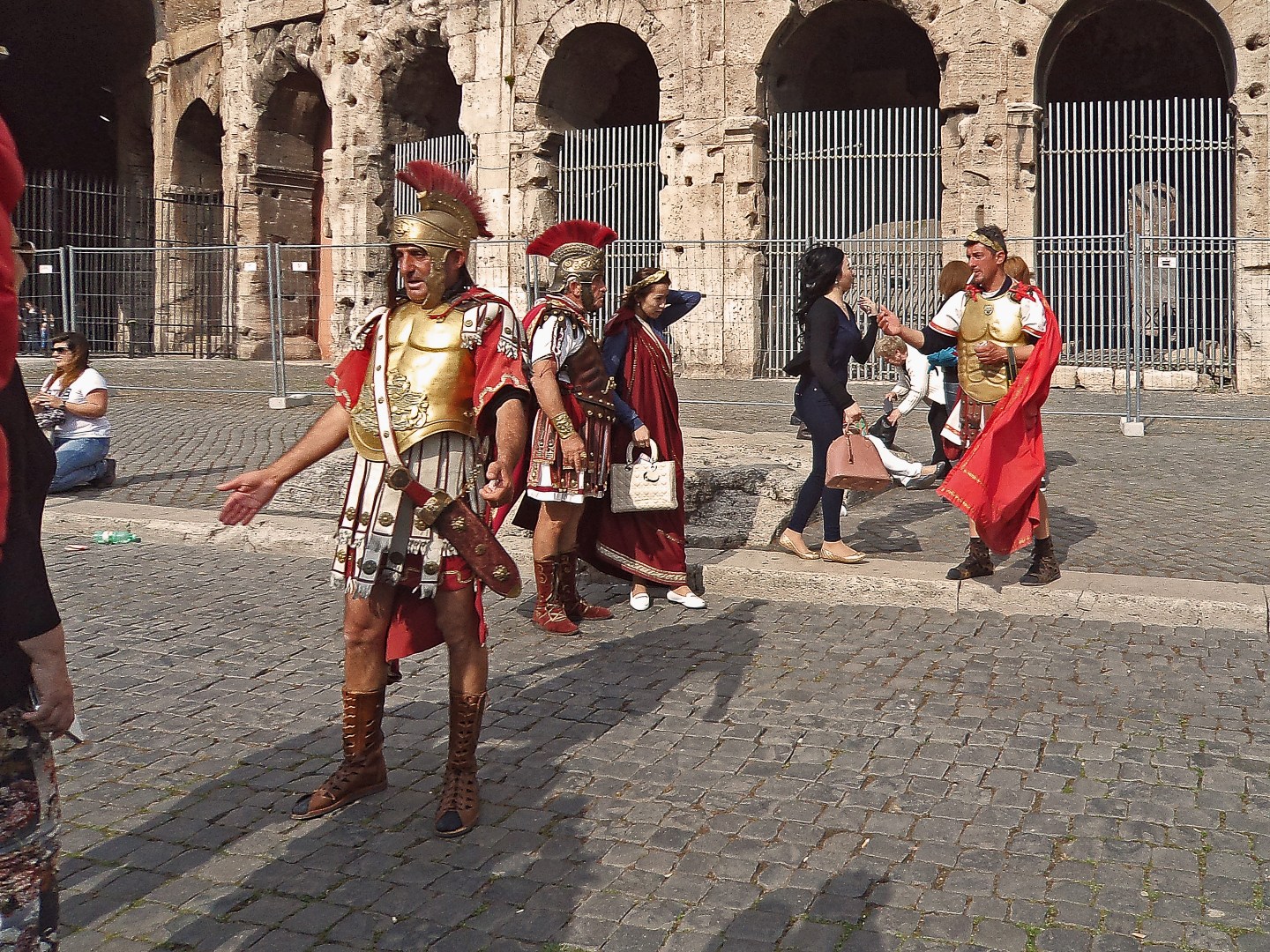
Then Paul talks about the armor of God. The armor: belt, breastplate, foot covering, shield, and helmet would have been easily recognizable to the people in the first century. The Roman legions were a formidable force, and their armor, especially the helmet and shield were a large part of the defense, that and the tight marching formation in battle, presenting the enemy with nothing but helmets, shields, and the business ends of swords and spears, as if a wall was approaching. Note: when the Romans were defeated, they were defeated by flanking maneuvers – not “allowed” in classic battles of that day. But if possible, especially with other Romans on horseback, you could attack from the side of the wall where the shield is out of position, and the armor is the weakest.
Looking at the actors in the photo above, you can see how a frontal attack would be hard to hit anything vital, especially hiding behind a huge shield that almost interlocks with the shields on either side, but a carefully fired arrow, aiming at the armpit would hit the soft spot.
But God’s armor are spiritual things. In using them, we defend ourselves, leaving the attack to God.
The analogy is as follows:
- Belt – truth
- Breastplate – righteousness
- Feet protection – gospel of peace
- Shield – Faith
- Helmet – Salvation
The shield of faith is said to be able to repel the flaming arrows of the evil one.
In the ending of this letter, Paul introduces the person delivering the message, Tychicus, who was sent to encourage the Ephesians.
As with his letters, Paul signs off mentioning peace, love, faith, and grace. Love is mentioned three times in the last two sentences. His salutations at the beginning and ending of his letters may seem repetitious, but the words are carefully used. If we come away from the reading of the letter with only those four concepts, we have grown in faith. For indeed, the doing of that faith depends on peace, love, and grace.
Some Serendipitous Reflections
Ephesians 5:22-6:9 Wives and Husbands, Parents and Children, Slaves and Masters 1. What counter-cultural principles from Paul can you work on to help you be a better spouse (or potential spouse)?
“2. What does it mean for you to honor your parents? How can this help improve relationships with them?
“3. Applying Paul’s teaching in 6:5-9 to your work environment, what will you do differently this week?”
Ephesians 6:10-6:24 The Armor of God 1. As you consider your armor, what parts are in good shape? What is moldy and rusty? What do you need to do to get ready for battle? What is at stake if you don’t?
“2. Paul was on the front lines of the battle (v.20). What evidence do you see of the battle in your life? Your church? Your community? Your nation? The world? What would it mean for you ‘to stand’ in these particular battlefields?
“3. What can you learn from Paul’s prayers (1:16- 18; 3:14-19; 6:19-20) about your prayers for others in your small group? For missionaries?
“4. Of the four key words in verses 23-24 (peace, love, faith, and grace), which means the most to you now? Why?
- Lyman Coleman, et al, The NIV Serendipity Bible for Study Groups
One set of questions stretches between Ephesians 5 and 6. The other set of questions covers the rest of Ephesians 6.
Substitute whatever group for any reference to a small group or ask who could come to your aid.
If you like these Thursday morning Bible studies, but you think you missed a few, you can use this LINK. I have set up a page off the home page for links to these Thursday morning posts. I will continue to modify the page as I add more.
Soli Deo Gloria. Only to God be the Glory.
 Thoughts from Mark "Hat" Rackley
What an image of the armor that Paul Paul saw
LikeLiked by 1 person
😃🙏
LikeLiked by 1 person
😃
LikeLiked by 1 person