In you, Lord my God,
I put my trust.
I trust in you;
do not let me be put to shame,
nor let my enemies triumph over me.
No one who hopes in you
will ever be put to shame,
but shame will come on those
who are treacherous without cause.
- Psalm 25:1-3
Praise the Lord.
Blessed are those who fear the Lord,
who find great delight in his commands.
- Psalm 112:1
How deserted lies the city,
once so full of people!
How like a widow is she,
who once was great among the nations!
She who was queen among the provinces
has now become a slave.
- Lamentations 1:1
How the Lord has covered Daughter Zion
with the cloud of his anger!
He has hurled down the splendor of Israel
from heaven to earth;
he has not remembered his footstool
in the day of his anger.
- Lamentations 2:1
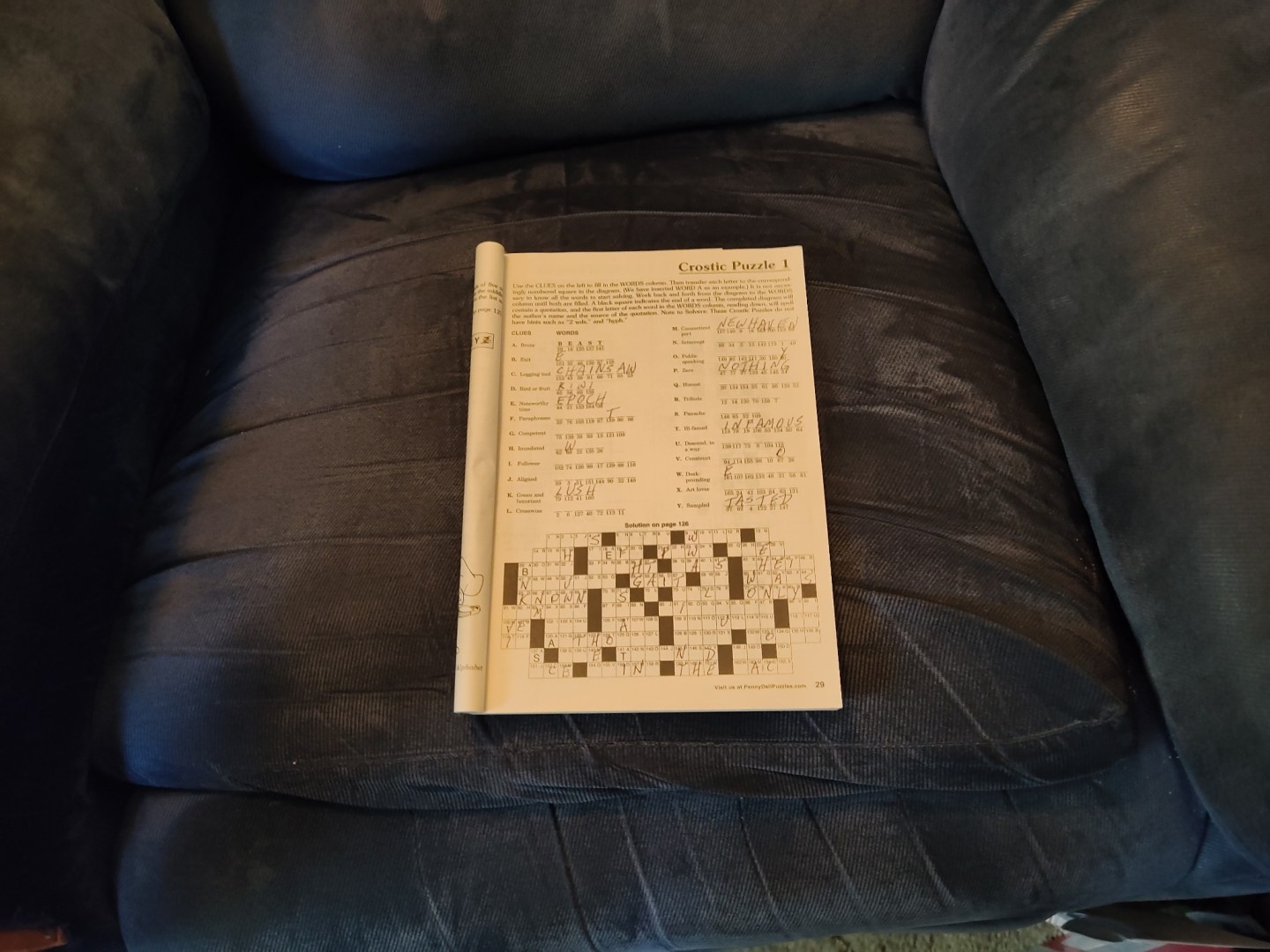
The photo is of a Crostic puzzle. They use the first and last letters of the clues to identify the author and the source of the quote. An acrostic is a literary form that starts each line, sentence, whatever with letters in a certain order, usually alphabetically.
The fortnightly (every other week) Bible Study Series on the book of Psalms has reached Psalm 119, the longest chapter in the Bible, 176 verses. But have you noticed how each set of eight verses, at least in many translations is proceeded by a Hebrew letter? Aleph, א; Beth, ב; Gimel, ג, and so on. In the Hebrew language, the following verses begin with that letter. The 176 verses are divided into 22 sets of eight verses each. The Hebrew alphabet has 22 letters, and this psalm has eight verses that start with each of those letters, in alphabetical order. This is called an acrostic. Of course, once you translate from the original language, the acrostic is usually lost.
Psalm 119 is not the only psalm written in acrostic fashion, and acrostics are not limited to the book of Psalms. An acrostic is not limited to poetic writings, but it is easier to display as poetry. Psalms that are acrostics, other than 119 are: 25, 34, 37, 111, 112, and 145.
The book of Lamentations is five chapters in length. The first four chapters are acrostics, with each verse being a new letter, except for Lamentations 3 which goes to the next letter of the Hebrew alphabet every three verses. Lamentations 5 is twenty-two verses, but it is not in acrostic form. It is the summary of the previous four chapters.
Another notable acrostic is the last twenty-two verses of the book of Proverbs. It is attributed to King Lemuel, but some scholars think Lemuel is a pen name of Solomon. These verses describe the wife of noble character.
So, you have the description of a wife of noble character, a description of how Judah had been sent into exile and what they had done to deserve such punishment, and a number of psalms. Psalm 119 is described by Matthew Henry as seeming to be King David’s ejaculations about how wonderful God is and how we should follow God’s commandments. The psalm is not attributed to David, but you might imagine someone assigned as a musical prophet, as Asaph was assigned, and they searched through the records finding some of David’s doodles. They put them together and massaged the sentence structure to have the verses in an acrostic form.
As one pastor’s podcast said, God inspires people to use acrostics when there are important lessons to learn.
I am treating each group of eight verses in Psalm 119 as a psalm unto itself. Psalm 119 (Beth) ב was discussed this morning, and the Psalm series will continue with three Hebrew letters until we finish Psalm 119.
Soli Deo Gloria. Only to God be the Glory.
 Thoughts from Mark "Hat" Rackley
It’s neat that they are in the Bible
LikeLiked by 1 person
Agreed. It takes care. Someone had to think it through.
LikeLiked by 1 person
yes
LikeLiked by 1 person