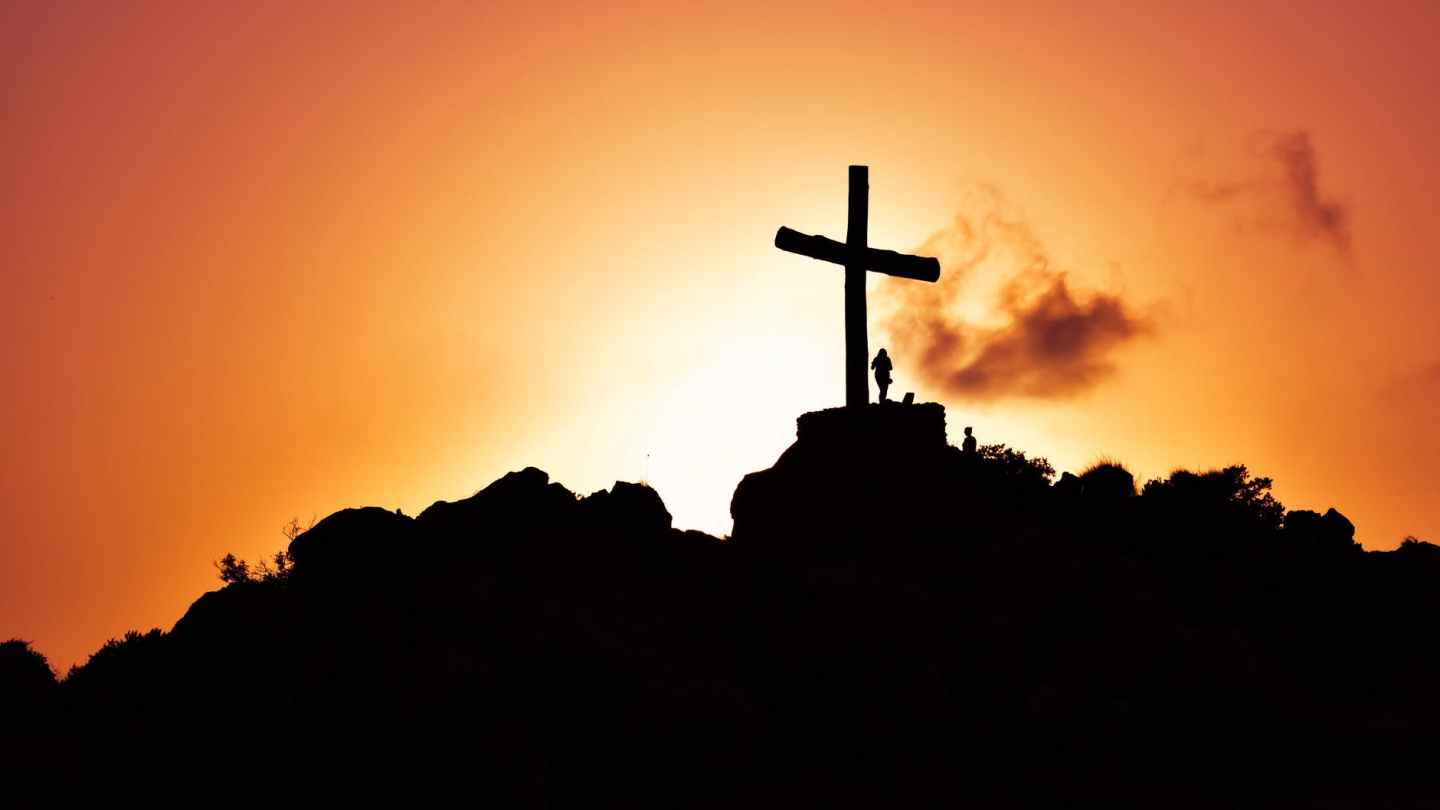
A certain man from Cyrene, Simon, the father of Alexander and Rufus, was passing by on his way in from the country, and they forced him to carry the cross. They brought Jesus to the place called Golgotha (which means “the place of the skull”). Then they offered him wine mixed with myrrh, but he did not take it. And they crucified him. Dividing up his clothes, they cast lots to see what each would get.
…
They crucified two rebels with him, one on his right and one on his left. Those who passed by hurled insults at him, shaking their heads and saying, “So! You who are going to destroy the temple and build it in three days, come down from the cross and save yourself!” In the same way the chief priests and the teachers of the law mocked him among themselves. “He saved others,” they said, “but he can’t save himself! Let this Messiah, this king of Israel, come down now from the cross, that we may see and believe.” Those crucified with him also heaped insults on him.
- Mark 15:21-24, 27-32
Pilate had a notice prepared and fastened to the cross. It read: Jesus of Nazareth, the king of the jews. Many of the Jews read this sign, for the place where Jesus was crucified was near the city, and the sign was written in Aramaic, Latin and Greek. The chief priests of the Jews protested to Pilate, “Do not write ‘The King of the Jews,’ but that this man claimed to be king of the Jews.”
Pilate answered, “What I have written, I have written.”
- John 19:19-22
Later, knowing that everything had now been finished, and so that Scripture would be fulfilled, Jesus said, “I am thirsty.” A jar of wine vinegar was there, so they soaked a sponge in it, put the sponge on a stalk of the hyssop plant, and lifted it to Jesus’ lips. When he had received the drink, Jesus said, “It is finished.” With that, he bowed his head and gave up his spirit.
- John 19:28-30
No one takes it from me, but I lay it down of my own accord. I have authority to lay it down and authority to take it up again. This command I received from my Father.”
- John 10:18
Later, Joseph of Arimathea asked Pilate for the body of Jesus. Now Joseph was a disciple of Jesus, but secretly because he feared the Jewish leaders. With Pilate’s permission, he came and took the body away. He was accompanied by Nicodemus, the man who earlier had visited Jesus at night. Nicodemus brought a mixture of myrrh and aloes, about seventy-five pounds. Taking Jesus’ body, the two of them wrapped it, with the spices, in strips of linen. This was in accordance with Jewish burial customs. At the place where Jesus was crucified, there was a garden, and in the garden a new tomb, in which no one had ever been laid. Because it was the Jewish day of Preparation and since the tomb was nearby, they laid Jesus there.
- John 19:38-42
John 19:31-32 ”Crucifixion often would take days to kill its victim. Breaking the victim’s legs caused the body to go into shock and hastened death. Roman law demanded that a criminal hang on the cross until he died, no matter how long that took. The body was then fed to the vultures. Jewish law, however, required that a body be removed the same day and buried before evening. The Jews could not allow a body to hang upon the cross on the Sabbath, which was the next day. Jesus’ legs were not broken, for he was already dead when the soldiers came and broke the legs of the criminals who were crucified on each side of him. The fact that none of Jesus’ bones were broken fulfilled another prophecy.”
- Dorothy Kelley Patterson, General Editor, NIV Woman’s Study Bible (Ann L. Bowman, Gospels and Acts contributor)
I believe in God, the Father almighty,
creator of heaven and earth.
I believe in Jesus Christ, God’s only Son, our Lord,
who was conceived by the Holy Spirit,
born of the Virgin Mary,
suffered under Pontius Pilate,
was crucified, died, and was buried;
he descended to the dead.
On the third day he rose again;
he ascended into heaven,
he is seated at the right hand of the Father,
and he will come to judge the living and the dead.
I believe in the Holy Spirit,
the holy catholic Church,
the communion of saints,
the forgiveness of sins,
the resurrection of the body,
and the life everlasting. Amen.
- Apostle’s Creed
The Message
There are different details in each of the Gospels regarding the crucifixion, death, and burial of Jesus. John brings more identification of people. Joseph of Arimathea is mentioned in all four gospels, but Nicodemus is only mentioned in John.
After the lack of a trial, with Pontius Pilate placating the riotous mob, Jesus is beaten before being sent to Golgotha. Simon of Cyrene is just passing through, but the Roman guards forced him to carry the cross for Jesus. Jesus had not slept. He was beaten. He had little energy to carry the cross, but He did so for some distance. In the Sermon on the Mount, Jesus talks about carrying someone’s cloak for a mile, under force, but then carrying the cloak a second mile. This was in reference to the Roman practice of taking people at random and making them do things. Taking the cloak a mile was often in the opposite direction to the direction that the Jew wanted to go. It was Rome telling the people that they had full control over the populace.
In stating that we believe in the crucifixion, death, and burial, the people writing the Apostle’s Creed were fighting the heresies of that day. Some said that Jesus did not die. Others stated that He was never buried.
Jesus Himself said that no one could take His life, but He would lay down His life for us. Jesus said, “It is finished.” Then, He gave up His spirit.
In focusing on prophecies. No bones were broken. He was pierced. People have speculated that the ordeal of the previous night and then the beating, probably one lash of the whip shy of death. Paul speaks of forty lashes minus one. In other words, one lash short of the amount needed to kill the ordinary man.
But the John passage says that Jesus gave up His spirit, willingly, of His own accord, when it was finished.
What was finished? God the Father had turned His back on Jesus, for Jesus carried our sins to the cross. He who was without sin became sin for our sake. The “it” in that statement by Jesus was that the debt had been paid. Jesus did not have to go to a physical Hell, He experienced that Hell on the cross. He experienced that separation from the Father, that rejection due to the sin of the world. But we will get to the statement about going to Hell next week.
He told the criminal on the cross next to Him that the criminal would be with Him in paradise that day. Thus, the debt was paid on the cross. Then, Jesus died earlier than expected, because Jesus gave up His spirit. And this led to no bones being broken and His body being pierced.
Jesus had friends in high places. Joseph of Arimathea and Nicodemus took the body to Joseph’s tomb. Both were members of the Sanhedrin. Did they keep their mouths shut or were they on the losing side of the vote to have Jesus crucified? But they both came forward to give Jesus a proper burial.
But the Sabbath started at sunset. They could not complete the preparation of the body. That would have to wait until Sunday.
And now let us sing.
The following song is Jesus Paid it All. This is sung by Kim Walker-Smith.
Closing Prayer
Dear Lord,
We believe in You. We trust You. Only the perfect Lamb of God could pay the price for our sin. You, oh Lord, suffered and died, giving up Your own life so that we could live in freedom. You spiritually went to the Father on Friday, but Your body rose on Easter. You conquered sin. You conquered death. All in one weekend. Praise Your Holy Name.
In Thy name we pray,
Amen
Soli Deo Gloria. Only to God be the Glory.


Leave a Reply