After I looked things over, I stood up and said to the nobles, the officials and the rest of the people, “Don’t be afraid of them. Remember the Lord, who is great and awesome, and fight for your families, your sons and your daughters, your wives and your homes.”
- Nehemiah 4:14
“I stood on [Bunker Hill] with hands uplifted, supplicating the blessings of Heaven to crown our unworthy arms with success. To us infantile Americans, unused to the thunder, the carnage of battle, the flames of Charlestown before our eyes-the incessant play of cannon from their shipping-from Boston, and their wings in various cross directions, together with the fire of musketry from more than four times our number, all heightened the majestic terrors of the field, exhibiting a scene most awful and tremendous. But amid the perils of the dread encounter, the Lord was our rock and fortress.
“[David] Avery was there in Boston when George Washington arrived to take control of the army. He stood in the ranks of Dorchester Heights on the morning the Americans took their brave stand; and when the British retreated, he exclaimed, ‘Give God the praise, for He hath done it.’
“Avery was with Washington during the retreat from New York, and he crossed the Delaware River with Washington during the attack on Trenton, later writing, ‘We were greatly distressed with a very cold storm of rain, hail, and snow which blew with great violence I was extremely chilled and came near to perishing before I could get to a fire.’ Washington later said that David Avery was the embodiment of all those qualities he wished in a chaplain.
“After the War, Avery returned to the pastorate, married, had ups and downs with his churches, and persevered in ministry until his death by typhus fever at age seventy-one. But he is most remembered in history as one of America’s first chaplains.
“The US Army Chaplain Corps, officially inaugurated by the Continental Congress on July 29, 1775, is virtually as old as the army itself. Since the first days of the American Revolution, chaplains like David Avery have been preaching, praying, and ministering among the troops, risking their lives on behalf of those who are risking their lives for us.
“What would America have done without them?”
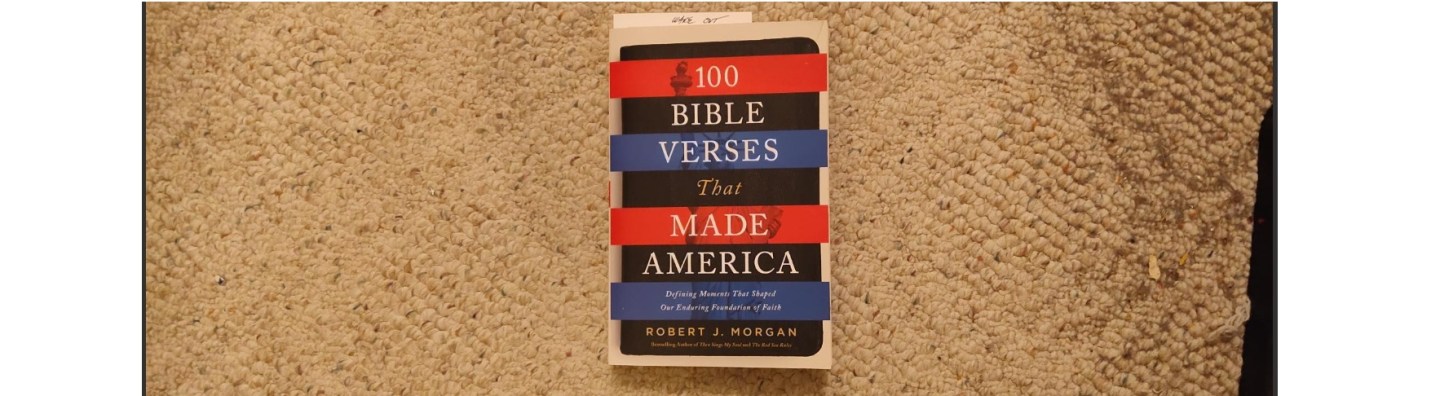
- Robert J. Morgan, 100 Bible Verses That Made America
In my recent trip to visit the grandchildren, the oldest of them went with me to Nashville, to sell used books and games. One of the books that I purchased in return was 100 Bible Verses That Made America by Robert J. Morgan. As we approach the 250th anniversary of the birth of the USA, I thought I would do a condensed mini-series on some of these verses, four posts per week for a few weeks – maybe not all 100 verses.
Here we have another pastor who accepted Jesus at a church meeting where George Whitefield was preaching. David Avery encouraged the men in his church to sign up for the Continental Army. In the excitement of the whole thing, he signed up along with them.
But what do you do with a thirty-year-old pastor? You make him a chaplain. Was there such a thing in the Army at the time? This was the Continental Army, and they were making things up as they went along. According to the U.S. Army online history, they had 218 unofficial chaplains in the Army at the time. No wonder the Chaplain Corps was established roughly the same time that the Army was officially established.
But Avery had a certain bearing about him. He got Washington’s attention. Washington is recorded as saying about Avery…
“Intrepid and fearless in battle, unwearied in his attentions to the sick and wounded—not only nursing them with care, but as faithful to their souls as though they were members of his own parish—with a love for his country so strong that it became a passion—cheerful under privations, and ready for any hardship—never losing in the turmoil of the camp that warm and glowing piety which characterizes the devoted minister of God.”
- J.T. Headley, The Chaplains and Clergy of the Revolution
The first brackets in the book’s quote comes from a quote from Avery himself. For the book, Breed’s Hill was changed to Bunker Hill. The Battle of Bunker Hill, famous in that the battle is taught any time the Revolution is studied, was fought on Breed’s Hill. Breed’s Hill was on the north side of the Charles River. When I lived there, I was on the north side of the Charles, but a few bends in the river to the west, and roughly 200 years after the battle. Charlestown, MA is not far away from Breed’s Hill, and they had a battle of their own. The town was on fire. Bunker Hill was in Charlestown.
But, in a way, Bunker Hill was part of that battle. Sharpshooters were using the high ground of Charlestown, upper floors of buildings on the hill. The sharpshooters were firing at soldiers that were getting off the boats, forming the battle lines at Breed’s Hill. Irritated that his men could not muster for battle properly, the general ordered the ships to bombard Charlestown with a combination of heated cannonballs and incendiary shells. The general did not care about the loss of life and property. He had a battle to win. The British took the hill, but at a great cost. The general lost 40% of his fighting force, and many of the lost were the elite light infantry forces. And Bunker Hill became a rallying cry for the colonists.
What I remember about the Battle of Trenton was that on Christmas Day, George Washington and the army was on the wrong side of the Delaware River. He got word from his spies that the British were too busy enjoying Christmas celebrations that they left guard duty to the Hessians. But the Hessians liked Christmas too. They were on guard, but they were drunk as skunks. The spies felt that only half could fire their weapons, and then half of those would end up with self-inflicted wounds. Trenton was sitting there ready for the taking.
But the problem was that Washington had no ferry boats to get an entire army across the river. But there were locals who had fishing boats. Washington spent all night ferrying a few soldiers over at a time. But with it being Boxing Day on 26 December, the British were still partying, and the Hessians were either passed out, hung over, or still drunk. And thus, the famous painting of Washington crossing the Delaware. In the rickety boat that he was in, he would not have been standing up. But it was his first decisive victory.
So, as Chaplain Avery speaks of nearly dying from the cold, that night he had to wait until the battle was over. A fire would give away their position, with very few men on the Trenton side of the river.
This has been more about military action than the Scripture above, but his sermon on Nehemiah 4:14 is what caused the men in his church to join the army, and after they all joined, he felt he had to go with them.
After all, do not fear. God has the battle well in hand.
And the fast inauguration of the Chaplain Corps showed that our founding fathers knew that it was God who saw them through the war. And they recognized the need for chaplains in the Army.
One of my best friends when in Europe for three years was the Army chaplain at Gerszewski Barracks in Karlsruhe, Germany. I value the work those chaplains did, and I served in peace time.
Soli Deo Gloria. Only to God be the Glory.


Nothing better than these firsthand accounts of historical events.
LikeLiked by 1 person
Thanks, I think in August, I will reduce it to once each week. I really like the accounts that the author carefully researched. Footnotes galore in each chapter. The USA was founded on Christian principles, and from many of these accounts, you can tell what Jefferson meant by a separation of church and state.
LikeLiked by 1 person
Great history on Chaplains
LikeLiked by 1 person
I’m learning things as I go through this, but I was good friends with the Gerszewski Chaplain in Karlsruhe and he argued that his branch was around longer than mine. A silly argument since Washington was an engineering officer building a road when war turned him into the leader he became.
LikeLiked by 1 person
LOl the military will always have rivalry
LikeLiked by 1 person