No, in all these things we are more than conquerors through him who loved us.
- Romans 8:37
“About that time he found something far more valuable. In 1834, an evangelistic meeting was held in a nearby stone church, and a challenge was given to those wanting to receive Christ. Cyrus, twenty-five, refused to stand. That night his father came to his bedside and gently said, ‘My son, don’t you know that your silence is a public rejection of your Savior?’
“Instantly smitten, Cyrus jumped out of bed and dressed. ‘I’ll go and see old Billy McClung,’ he said. He went down the road and woke up the man, who led him to saving faith. The next Sunday Cyrus stood in church, making public his decision.
“On June 21, 1834, McCormick took out a patent on his reaper and began offering them for fifty dollars each, but no one bought one-not for years. Rather than being a millionaire, McCormick began drowning in debt. ‘If it were not for the fact that Providence has seemed to assist me,’ he said, ‘I would almost sink … but I believe the Lord will help us out.’ His favorite Bible passage was Romans 8, with its great verse 37: ‘Yet in all these things we are more than conquerors through Him who loved us.’
“Romans 8 serves as the climax for Paul’s great discussion of the truth of Jesus Christ as our Savior. From Romans 1 through Romans 8, the apostle lays out his case that only Christ Himself can provide us with peace with God, forgiveness of sin, and an eternal hope in heaven. The entire last half of Romans 8 is a great shout of triumph. It’s well worth memorizing, for it reminds us that regardless of our perils and problems in life, we are not just victorious through Christ-we are more than conquerors.”
- Robert J. Morgan, 100 Bible Verses That Made America
In my recent trip to visit the grandchildren, the oldest of them went with me to Nashville, to sell used books and games. One of the books that I purchased in return was 100 Bible Verses That Made America by Robert J. Morgan. As we approach the 250th anniversary of the birth of the USA, I thought I would do a condensed mini-series on some of these verses, four posts per week for a few weeks – maybe not all 100 verses.
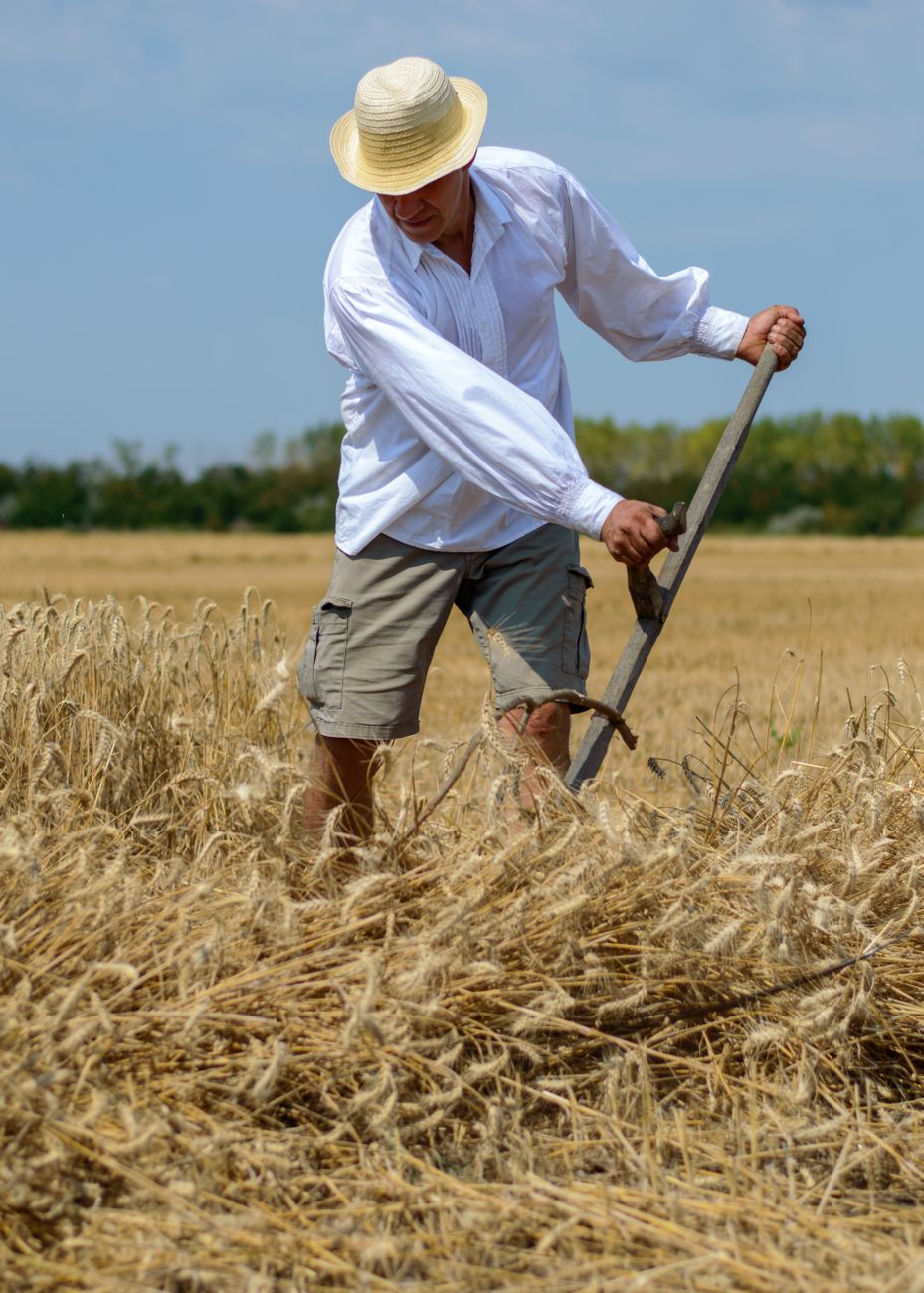
Cyrus McCormick had designed his reaper because clearing a large field by hand with nothing but a scythe was back breaking work. He was told the reapers were worth one hundred thousand dollars based on the labor cost that it saved. He thought he’d build 100 of them and become a millionaire.
But as the quoted part of the story is told, once he became a Christian, he felt 100 dollars per reaper would be sufficient profit to keep his enterprise going, but as they did not sell, he cut the price in half.
It was a total stranger that bought the first one, then another stranger bought another. He found that most of his sales were from the Midwest, Illinois, Indiana, and Iowa. He moved to Chicago, built a factory and indeed, became a millionaire.
But he noticed that they had few churches in the Midwest at the time. He started donating large sums of money to build churches and hopefully a seminary.
It was about this time that D.L. Moody started his evangelism work. McCormick became his largest backer, including $50,000 to start a college. That college today is known as Moody Bible Institute.
And it all started with a young man thinking of a better way to reap grain fields, and how he met the Savior.
I have used a scythe to cut grass, a larger scythe with a handle about four feet long. The balance of a scythe (held with both hands, one at the end and the other on a side handle in the middle) was completely different than the more modern sling blade, a straight handle with a blade on the end. Both were back breaking tools, but the gullies in front of our house on the farm were too steep for a conventional lawnmower. And using them was different. The scythe was a smooth circular swing, while a sling blade was a chopping motion. Weed eaters put those old tools out of business. But I only cleared the banks of the gullies two or three times each spring, summer, and fall. When I left for college, my Dad eventually bought a riding lawnmower, and then a tractor with a bushhog. It usually took me two and a half days to mow the lawn weekly, all with a push mower, and that did not include the gullies. Scythes are easier to use when the “grain” is fully grown, so for grass knee high was about right, but I had to keep an eye out for snakes. And my Dad kept both the scythe and the sling blade sharp enough to “cut you just by looking at it,” but it took a lot of physical work. No wonder I stayed in shape in those days.
But I was sent down memory lane when I was in Germany and the people in Bavaria and the Black Forest would not use lawnmowers, but they kept their lawns immaculate using a small hand-held scythe or the two-hand scythe that I had used in my teenaged years. Usually for the same reason – rugged terrain.
Soli Deo Gloria. Only to God be the Glory.


Leave a Reply