Scripture Passages
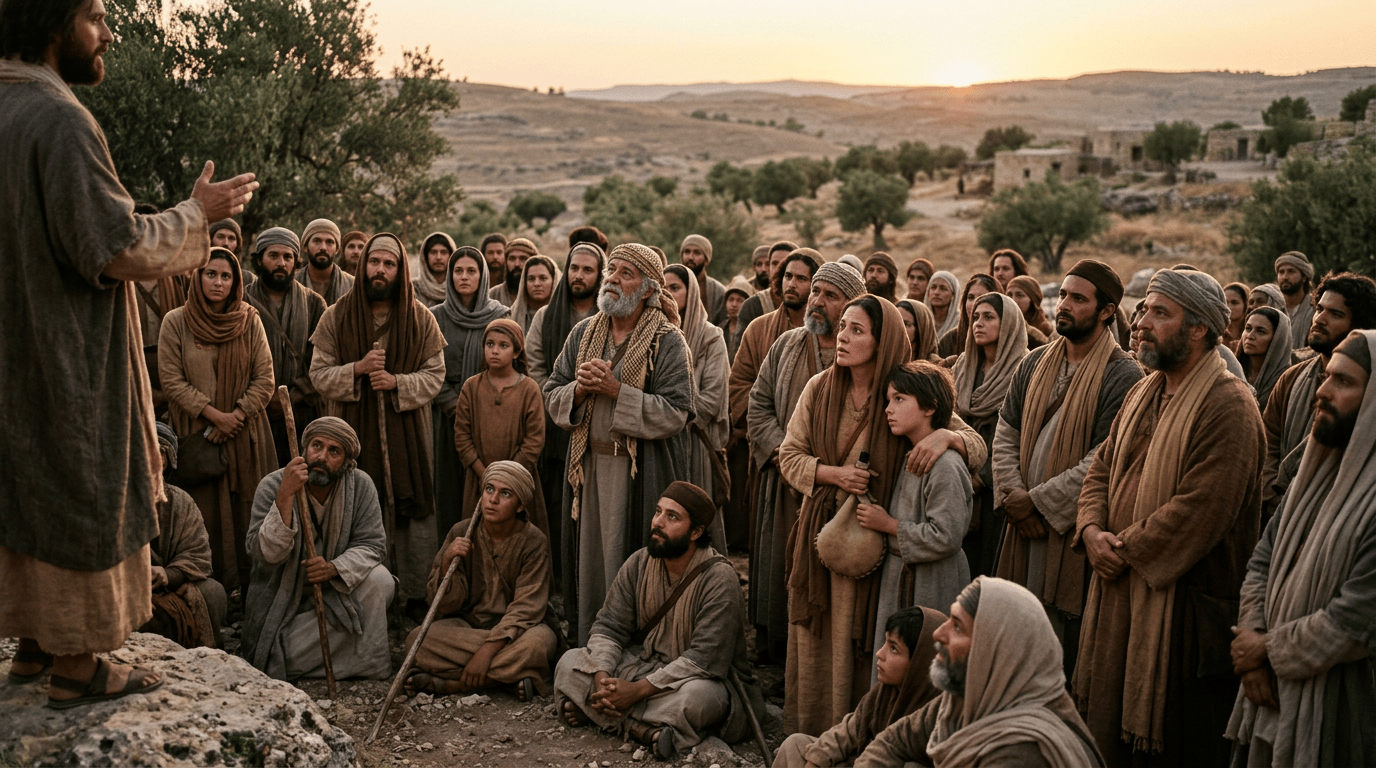
The next day John was there again with two of his disciples. When he saw Jesus passing by, he said, “Look, the Lamb of God!”
When the two disciples heard him say this, they followed Jesus. Turning around, Jesus saw them following and asked, “What do you want?”
They said, “Rabbi” (which means “Teacher”), “where are you staying?”
“Come,” he replied, “and you will see.”
So they went and saw where he was staying, and they spent that day with him. It was about four in the afternoon.
Andrew, Simon Peter’s brother, was one of the two who heard what John had said and who had followed Jesus. The first thing Andrew did was to find his brother Simon and tell him, “We have found the Messiah” (that is, the Christ). And he brought him to Jesus.
Jesus looked at him and said, “You are Simon son of John. You will be called Cephas” (which, when translated, is Peter).
The next day Jesus decided to leave for Galilee. Finding Philip, he said to him, “Follow me.”
Philip, like Andrew and Peter, was from the town of Bethsaida. Philip found Nathanael and told him, “We have found the one Moses wrote about in the Law, and about whom the prophets also wrote—Jesus of Nazareth, the son of Joseph.”
“Nazareth! Can anything good come from there?” Nathanael asked.
“Come and see,” said Philip.
When Jesus saw Nathanael approaching, he said of him, “Here truly is an Israelite in whom there is no deceit.”
“How do you know me?” Nathanael asked.
Jesus answered, “I saw you while you were still under the fig tree before Philip called you.”
Then Nathanael declared, “Rabbi, you are the Son of God; you are the king of Israel.”
Jesus said, “You believe because I told you I saw you under the fig tree. You will see greater things than that.” He then added, “Very truly I tell you, you will see ‘heaven open, and the angels of God ascending and descending on’ the Son of Man.”
- John 1:35-51
Chronological Study Bible Notes
Beginning of the Public Ministry
“The Fourth Gospel emphasizes that John the Baptist was the one who came ‘to bear witness of the Light’ (John 1:6, 7, 34). In keeping with this emphasis, the Gospel writer John begins his account of Jesus’ ministry by reporting that the first persons to follow Jesus were responding to the Baptist’s testimony. Previously Andrew had been a disciple of the Baptist (1:35–37, 40).
“The place where the Baptist had been baptizing disciples is reported in John 1:28 as Bethabara of Judea in some Greek manuscripts and as Bethany of Perea in others. Neither place can be located with certainty. Many of Jesus’ earliest followers, however, were from areas farther north surrounding the Sea of Galilee, such as Bethsaida (1:44). This group of followers increased as they told family members and friends about Jesus (1:41, 45), and as Jesus Himself summoned people, ‘Follow Me’ (1:43). Jesus shortly left the region of the Baptist’s ministry at the Jordan River and went to Galilee (1:43).”
- Timothy B. Cargal, et al., The Chronological Study Bible
Other Commentary
Nazareth (John 1:46)
Jesus gave prominence to Nazareth, a city not mentioned in the OT. Located between the Sea of Galilee and the Mediterranean Sea, Nazareth was Jesus’ hometown, where he grew from boyhood to manhood. With Nathanael’s question, John revealed Nazareth’s poor reputation. The people of Nazareth would later reject Jesus (see Mk 6:4, note).
- Dorothy Kelley Patterson, General Editor, NIV Woman’s Study Bible (Ann W. Bowman, Gospels and Acts contributor)
“They followed Jesus” (John 1:37)
Although the verb ‘follow’ usually means ‘to follow as a disciple’ in the writing of the apostle (v. 43; 8:12; 12:26; 21:19, 20, 22), it may also have a neutral sense (11:31). The ‘following’ here does not necessarily mean that they became permanent disciples at this time. The implication may be that they went after Jesus to examine Him more closely because of John’s testimony. This event constituted a preliminary exposure of John the Baptist’s disciples to Jesus (e.g., Andrew; 1:40). They eventually dedicated their lives to Him as true disciples and apostles when Jesus called them to permanent service after these events (Matt. 4:18–22; 9:9; Mark 1:16–20). At this point in the narrative, John the Baptist fades from the scene, and the attention focuses upon the ministry of Christ.
- John MacArthur, John MacArthur Commentary (quoted Scripture without bold/italics)
My Thoughts
Two of John’s Disciples Follow Jesus (John 1:35-42)
John the Baptist turns to his disciples and tells them that Jesus is the Lamb of God.
They leave John to inquire where Jesus was staying. Jesus had them follow Him.
They spent the rest of the day talking with Jesus.
One of the two disciples was Andrew, the brother of Simon. Andrew wastes no time to find his brother and bring him to Jesus. Then, Jesus tells Simon that his name will be Peter.
The text never says anything about who the other disciple of John the Baptist was. It was probably John, brother of James. John never mentions his own name in his Gospel. To keep that trend, he focuses on the other pair of brothers.
But we can use the same logic that was used in a recent fictional story. Mark’s gospel is the only one that talks about the young boy who lost his only garment when escaping the guards at Gethsemane, and he ran away naked. This might have been John Mark, since most scholars think they stayed at the home of John Mark’s mother Mary. Here, we see two disciples, and the author identifies the other one and what happened next. It is not a showstopper even if it is not John, but John got this unique information personally to be the only one to record it.
And note: Two disciples are mentioned by John. There could have been more, but John the Baptist still had followers after John was killed and Jesus had been crucified, resurrected, and ascended. Apollos was a follower of John, who believed in Jesus, but Aquila and Priscilla taught Apollos about the baptism of the Holy Spirit (Acts 18:24-28).
Jesus calls Philip and Nathaniel (John 1:43-51)
Philip is asked to follow Jesus. He does so.
Philip does as Andrew had done. He goes to Nathaniel, and he tells him that Jesus is the One that Moses had written about.
Nathaniel suggests that nothing good comes from Nazareth. I have lived the last thirty years of my life in the Pittsburgh area, and if you said someone important came from Cleveland, they would have the same reaction. I doubt if there was a sporting rivalry, but we are talking about Nazareth caught between the Sea of Galilee and the Mediterranean Sea, along the high country north of the Valley of Jezreel while Bethsaida was in a more prominent location on or near the Sea of Galilee. Bethsaida has not been positively identified by modern researchers. I do not think that the disciples from there care whether we know where their birthplace is. But they do care if we know the Savior who found them there.
Even after seeing Jesus, Nathaniel was not impressed until Jesus told him what he was doing before Philip ran to him. Jesus says that His disciples will see greater things. Those things include angels ascending and descending to the Son of Man.
This only includes the John account, and the Chronological Study Bible places a few events from John before going back to the Sea of Galilee to call some of the same disciples.
We can think of this as stages of following. As mentioned earlier, I have been in the Pittsburgh, PA, USA area for over thirty years. But I only “follow” the Pittsburgh Steelers from afar. One of their Super Bowl wins in the past thirty years was when I went to a Super Bowl watch party at a friend’s house, a church friend. Otherwise, I watch the games from home. I do not own a jersey. I have not been to a game, not even pre-season. I do not have season tickets.
It is one thing to watch the games and root for the team. It is more dedication, and money, to own the gear while doing it. It is even more dedication and money to buy tickets to the games, and even more to go to the away games.
So, Jesus had people that followed Him when He was local. Then when He took a road trip somewhere else, He might only have a few that went on the road. And when we get to those other calls to be disciples, we will see that some left their livelihood and followed Him. The call to return to fishing led to Jesus having a breakfast fish fry on the shore after He rose from the dead. The Twelve, plus others, had left everything and followed Jesus. Not knowing what to do after Jesus died, some went back to fishing. But they soon learned that being an apostle was a full-time job.
But the 72 followed Jesus closely until the problem of understanding in John 6. The Twelve were there for the majority of His ministry. But with the first calling, especially if those two John the Baptist disciples were Andrew and John, then the trip along the seashore and stepping into Peter’s boat to preach to the crowd… In that interlude, the disciples went back to fishing.
But one key observation in what John wrote about the early followers of Jesus is that they did not keep what they had found to themselves. They told family and friends. We see this throughout the gospels. The shepherds went throughout Bethlehem. The woman at the well went into town and told everyone. And on and on. We are called to do likewise.
Soli Deo Gloria. Only to God be the Glory.


Leave a Reply