The vision of Obadiah.
This is what the Sovereign Lord says about Edom—
We have heard a message from the Lord:
An envoy was sent to the nations to say,
“Rise, let us go against her for battle”—
“See, I will make you small among the nations;
you will be utterly despised.
The pride of your heart has deceived you,
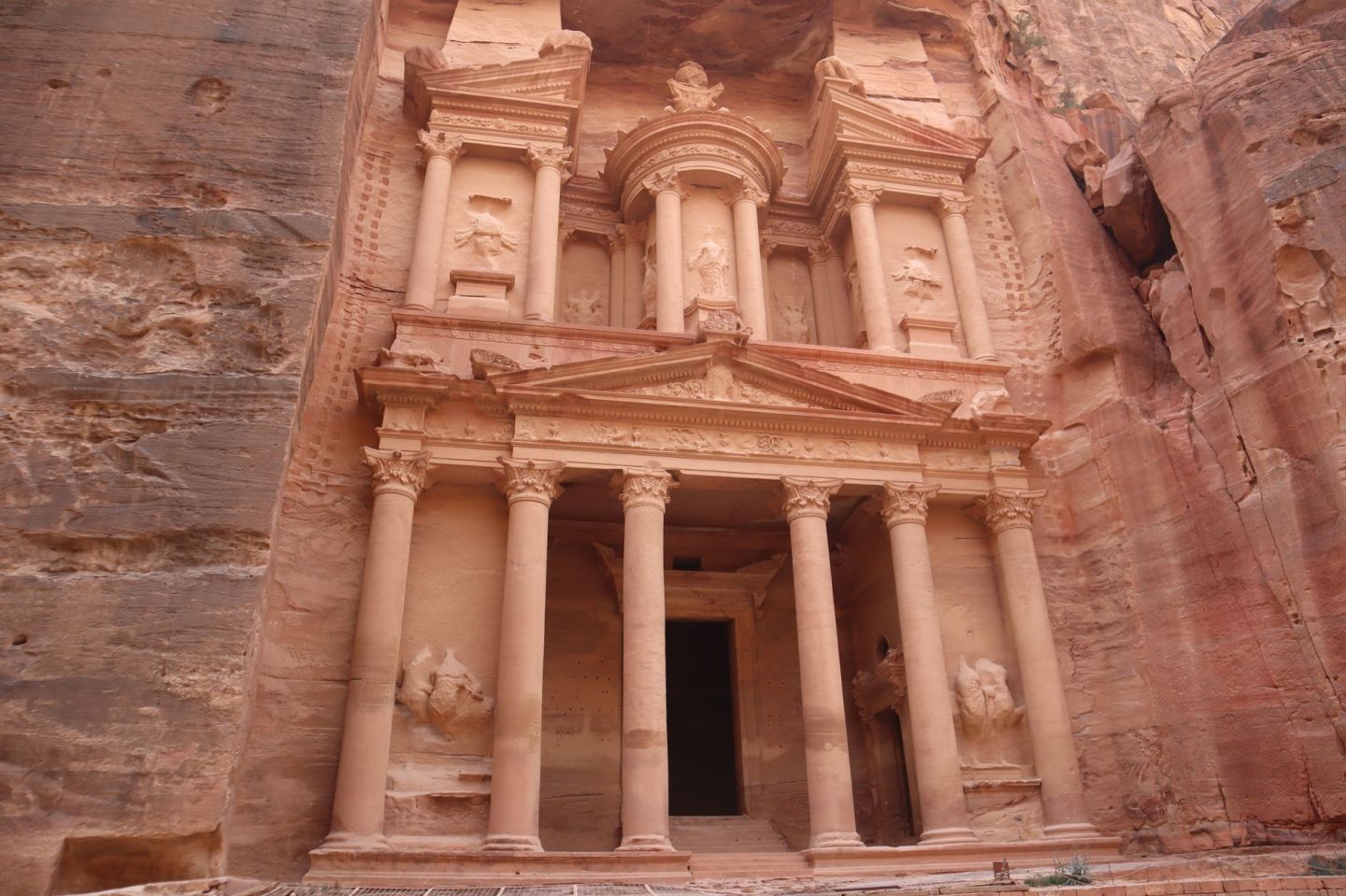
you who live in the clefts of the rocks
and make your home on the heights,
you who say to yourself,
‘Who can bring me down to the ground?’
Though you soar like the eagle
and make your nest among the stars,
from there I will bring you down,”
declares the Lord.
“If thieves came to you,
if robbers in the night—
oh, what a disaster awaits you!—
would they not steal only as much as they wanted?
If grape pickers came to you,
would they not leave a few grapes?
But how Esau will be ransacked,
his hidden treasures pillaged!
All your allies will force you to the border;
your friends will deceive and overpower you;
those who eat your bread will set a trap for you,
but you will not detect it.
“In that day,” declares the Lord,
“will I not destroy the wise men of Edom,
those of understanding in the mountains of Esau?
Your warriors, Teman, will be terrified,
and everyone in Esau’s mountains
will be cut down in the slaughter.
Because of the violence against your brother Jacob,
you will be covered with shame;
you will be destroyed forever.
On the day you stood aloof
while strangers carried off his wealth
and foreigners entered his gates
and cast lots for Jerusalem,
you were like one of them.
You should not gloat over your brother
in the day of his misfortune,
nor rejoice over the people of Judah
in the day of their destruction,
nor boast so much
in the day of their trouble.
You should not march through the gates of my people
in the day of their disaster,
nor gloat over them in their calamity
in the day of their disaster,
nor seize their wealth
in the day of their disaster.
You should not wait at the crossroads
to cut down their fugitives,
nor hand over their survivors
in the day of their trouble.
“The day of the Lord is near
for all nations.
As you have done, it will be done to you;
your deeds will return upon your own head.
Just as you drank on my holy hill,
so all the nations will drink continually;
they will drink and drink
and be as if they had never been.
But on Mount Zion will be deliverance;
it will be holy,
and Jacob will possess his inheritance.
Jacob will be a fire
and Joseph a flame;
Esau will be stubble,
and they will set him on fire and destroy him.
There will be no survivors
from Esau.”
The Lord has spoken.
People from the Negev will occupy
the mountains of Esau,
and people from the foothills will possess
the land of the Philistines.
They will occupy the fields of Ephraim and Samaria,
and Benjamin will possess Gilead.
This company of Israelite exiles who are in Canaan
will possess the land as far as Zarephath;
the exiles from Jerusalem who are in Sepharad
will possess the towns of the Negev.
Deliverers will go up on Mount Zion
to govern the mountains of Esau.
And the kingdom will be the Lord’s.
- Obadiah 1:1-21
Noted Biblical Scholars, Teachers, and Preachers Comments
Obadiah ‘Overview’: “Obadiah’s name means “servant of the Lord,” but beyond that, nothing certain is known about this prophet. The book’s message, though, is clear: judgment upon Edom. The Edomites had acted treacherously against the inhabitants of Jerusalem during their darkest hour. They had laughed at Judah’s sorrow, probably looted the hapless people, and helped the Babylonian soldiers find fleeing refugees. Edom, descended from Israel’s brother Esau, had betrayed that brotherhood. Now Edom would be punished.
“The date of the book is not completely certain; it could be referring to any number of times that Edom opposed Judah. Various verses, however, fit particularly well with the time after the fall of Jerusalem in 586 B.C. Not only does Obadiah refer to the destruction of Jerusalem and a captivity (Obad. 1:11, 12), but he also appears to quote from a prophecy of Jeremiah’s (Obad. 1:5; Jer. 49:7–9).”
- Timothy B. Cargal, et al., The Chronological Study Bible
Obadiah 1:1-9 ‘The Destruction of Edom’: “The first division describes Edom’s destruction, and is comprised of three smaller units. The first unit is in verse 1, which contains a call to the nations. An ambassador (‘envoy’) is sent out to the nations. The Hebrew word translated ‘envoy’ is a word that normally means ‘angel.’ An angel is sent out to stir up the nations against Edom. God frequently uses angels co carry out His will among the nations, and chat is the case here. After this angel has done his work, the nations will say, ‘Arise and let us go against her for battle’ (verse 1). The nations will call for war against Edom.
“The second unit, verses 2-4, announces that the pride of Edom will be destroyed. Edom’s population is co be greatly reduced as a result of divine judgment (verse 2). Obadiah points out that Edom’s pride was in her security: she dwelled among the rocks (verse 3). The two major cities in Edom, Sela and Bozrah, were located in a range of mountains in Edom known as Mount Seir. These mountains rise up suddenly from the plain and are very majestic. It would have been very difficult for an enemy to execute a full-scale onslaught against these cities in the clefts of these rocks. le was because of Edom’s protective place in the mountains that the nation was proud. Bue Obadiah says that Edorn’s pride will be brought down (verse 4). Even the seemingly invincible Mount Seir could not protect the people from God’s judgment. In the third unit, verses 5-9, Obadiah emphasizes the totality of Edom’s destruction. Obadiah begins by contrasting the incomplete and the complete (verses 5-6). First he addresses the incomplete (verse 5). When robbers break into a home, they do not take every single item in the house; some things are always left behind. Even when people glean the fields they do not manage to get all the crop. Inevitably, little bits are left here and there. But that won’t happen with Edom’s judgment (verse 6). The city will suffer complete destruction. There will be nothing hidden that will escape. Those who will despoil the Edomites will take everything until nothing is left.”
- Tim LaHaye and Ed Hindson, Exploring Bible Prophecy
Obadiah 1:1 ‘Edom descended from Esau’: “The nation Edom descended from Esau, Jacob’s brother. Esau and Jacob were twins whose rivalry began in the womb as the younger Jacob held Esau’s heel at birth (Ge 25:22–26), thus depicting the struggle between the two brothers. The rivalry between the two was repeated in the history of the two nations that descended from them. Obadiah announced that Edom’s day of reckoning had come as God summoned the nations as instruments of his wrath (see Nu 20:14–21; 1Ki 11:15–17; 2Ki 8:20–22; 2Ch 28:17).”
- Dorothy Kelley Patterson, General Editor, NIV Woman’s Study Bible (Karen H. Jobes, Minor Prophets contributor)
Obadiah 1:2-4 ‘battle between flesh and spirit’: ”What is so important about these two men and these two nations? That is what the book of Obadiah makes clear. In the struggle between Edom and Israel in the Old Testament, we see a parallel with a similar struggle that is described for us in the New Testament-the Christian’s struggle between the flesh and the spirit.
“In Galatians 5:17, Paul tells us that the flesh lusts against the spirit and the spirit against the flesh; they are opposed to one another. God always uses pictures so we can understand His truth more fully. The picture of Esau and Jacob, of Edom and Israel, represents for us the conflict between the flesh and the spirit.
“This is a valuable key to Bible study. Once we learn to recognize the ‘interpretational constants’ in Scripture-the symbols, images, names, and metaphors that consistently signify important truths-many hard-to-understand biblical concepts soon become clear. For example, certain symbols have a constant meaning wherever you find them in the Old and New Testaments: Oil is almost always a symbol for the Holy Spirit; wine symbolizes joy; leaven is always a picture of evil. And these two men, Jacob and Esau, and the nations Israel and Edom, always symbolize the struggle between the spirit and the flesh.“
- Ray C. Stedman, Adventuring Through the Bible
Obadiah 1:2 ‘A great people brought low’: ”This great people—they were a great people, as we are going to see in this book—are now going to be brought down. Obadiah gives this as a prophecy which looks to the future, but from where we stand today, we see that it has been fulfilled.
“What was the great sin of Edom which brought about God’s judgment upon her?”
- J. Vernon McGee, Thru the Bible, Vol III, Proverbs to Malachi
Obadiah 1:3, 11 ‘Prayer Warriors’: “When you have a bitter rivalry in sports, it isn’t natural to turn around and think you should now pray for the well-being of your adversaries. Rodney Harrison and I faced off several times in crucial games when he was with the New England Patriots and I was with the Colts. Now, however, we’re on the same team, working on the show Football Night in America for NBC.
“I wish I could look back and say I prayed for him then the way I’m praying for him now. It’s natural now that I know him personally and see him regularly. We are part of each other’s lives, and I have a much better understanding of him and who he is. But we’ve got to work hard to see that the people we disagree with have the same good qualities we do. I should have realized that was true about Rodney even when he and his teammates had the upper hand on the football field so many times.
“In his twenty-one-verse book in the middle of the Bible, the prophet Obadiah clearly proclaims that even if we feel the situation warrants it, God does not want us to relish the misfortune of others. At the time Obadiah wrote this, the descendants of Jacob and Esau were still having disputes, and the Edomites (Esau’s people) rejoiced in the fall of Jerusalem (Jacob’s people). Obadiah sternly warned the Edomites that their own end was approaching because of their attitude-namely, their desire for revenge, their pride, and their rejoicing in the suffering of their enemies.”
- Tony Dungy with Nathan Whitaker, Uncommon Life – Daily Challenge (excerpt from devotion for 20 August)
Obadiah 1:3 ‘The Son of Pride’: ” The Edomites benefited from the peculiar geography of their land. It was a region of rugged mountains with high cliffs and narrow valleys. This dissuaded any invader from attacking. This was also gave Edom a false sense of pride and security. But even entrenched evil is never totally secure.
“Pride remains a problem today. People overconfidently say, ‘oh, that will never happen to me.’ I find intentionally placing myself among disadvantaged people helps keep my pride in check. For example, whenever I make pastoral visits to the skilled care area of a senior living facility, I am reminded these residents were once like me. They had healthy bodies and sound minds. This reflection grants me a humble perspective.”
- Jay McCluskey, A Long Walk with the Minor Prophets
Obadiah 1:4 ‘Esau’: ”That is the pride of the flesh. That is Esau. That is Edom. The lord answers the proud in the book of Obadiah.“
- Ray C. Stedman, Adventuring Through the Bible
Obadiah 1:5 ‘rhetorical questions’: “Obadiah used rhetorical questions to emphasize the completeness of God’s judgment. Unlike ‘robbers’ or ‘grape pickers’ the nations brought against Edom will leave nothing behind.”
- Dorothy Kelley Patterson, General Editor, NIV Woman’s Study Bible (Karen H. Jobes, Minor Prophets contributor)
Obadiah 1:8 ‘wise men’: “Edom was known for her wise men and sages (Jer. 49:7). Her location on the King’s Highway provided her with intellectual stimulation with India, Europe, and North Africa.”
- John MacArthur, John MacArthur Commentary (quoted Scripture without bold/italics)
Obadiah 1:9 ‘Teman’: ” Teman (lit. ‘south’) is another name for the entire country of Edom.”
- Dorothy Kelley Patterson, General Editor, NIV Woman’s Study Bible (Karen H. Jobes, Minor Prophets contributor)
Obadiah 1:10-14 ‘The Reason for Judgment’: “In the second major division of the book, Obadiah reveals the reason for the destruction of Edom. Why is God rendering such havoc upon the Edomites? Why is He so adamant about bringing total destruction? In verses 10-14, Obadiah spells out six reasons.
“The first reason is Edom’s violence against brother Jacob (verse 10). The violence of Edom against Israel is the violence of a brother against a brother. That makes the crime much more hideous. The result of this crime is that Edom will be shamed by being ‘cut off forever’ (verse 10). This again emphasizes Edom’s total destruction.
“The second reason is Edom’s hostile attitude toward the Jews as evidenced when Edom stood back and failed to help the Israelites when foreigners attacked, sacked, and despoiled Jerusalem. The Edomites should have come to Israel’s rescue. Instead, they cast lots for Jerusalem. They wanted to share in the spoil. While they were not actually a part of the fighting force, once they saw the Jews losing the battle, the Edomites began planning to join the enemies in partaking of the spoil. Obadiah says, ‘You too were as one of them’ (verse 11). While Edom was not involved in the actual attack and war, she participated in the looting. For all practical purposes, she was just as guilty as those who instigated the sacking of Jerusalem.
“The third reason Edom is to suffer is because of her glee over the fall of Jerusalem (verse 12). Not only were the Edomites characterized by a hostile attitude, but they were delighted and rejoiced over the collapse of Jerusalem. Although the Edomites were told, ‘Do not gloat… do not rejoice… do not boast in the day of their distress’ (verse 12), they were guilty of all these things.
“The fourth reason for God’s judgment is that the Edomites joined in on the spoiling of Jerusalem (verse 13). Although they were not to enter into the gate of God’s people during the day of their calamity, they entered in anyway. Although they were not to look on the affliction of Jerusalem, they looked with glee anyway. Although they were to lay no hand on the Jews’ wealth, they joined in on the spoiling of the city.
“The fifth reason Edom is destined for a total destruction is that the Edomites had blocked the escape routes for the Jews who were fleeing Jerusalem (verse 14). The Edomites did not let the Jews pass by; instead, they blocked the escape routes so the Jews could not escape.
“The sixth reason for God’s judgment against Edom was that the Edomites had captured the fleeing Jews and turned them over to the enemy, who made them slaves.”
- Tim LaHaye and Ed Hindson, Exploring Bible Prophecy
Obadiah 1:10 ‘family ties’: “Your brother Jacob refers to the common ancestry between Edom and Israel. On the basis of this family tie, God commanded Israel to treat Edom with special consideration (Dt 23:7). Edom’s violation of this special relationship made her crimes more heinous.”
- Dorothy Kelley Patterson, General Editor, NIV Woman’s Study Bible (Karen H. Jobes, Minor Prophets contributor)
Obadiah 1:10 ‘Violence – Pride in action’: ”Pride takes many forms – including violence. Whenever one person acts violently toward another, that is fleshly pride in action.“
- Ray C. Stedman, Adventuring Through the Bible
Obadiah 1:11 ‘The Sin of Indifference’: ” When the Hebrews were falling and suffering, Edom failed to come to the aid of their distant cousins. This was a sin of omission. Rather than helping their relatives, they stood aloof.
“Some municipalities have ‘bystander laws.’ These laws make it a crime for a person to not render assistance to a person in danger. This was the crime of the Edomites. They stood by while the Hebrews suffered.”
- Jay McCluskey, A Long Walk with the Minor Prophets
Obadiah 1:12-13 ‘sin of gloating’: ”God charges Edom with the sin of gloating over the misfortunes of others-another manifestation of pride. Did you ever take satisfaction in someone else’s hurt? Perhaps you have thought, ‘He had it coming!’ or ‘Serves her right!’ Why do we find pleasure in someone else’s sufferings? Why do we delight in rubbing salt into open wounds? Why do we enjoy gossiping about the faults and failures of other people? It’s the Esau in us. It’s pride. It’s the flesh warring against the Spirit of God. “
- Ray C. Stedman, Adventuring Through the Bible
Obadiah 1:12 ‘rejoicing over calamity’: “They rejoiced over the calamity that had come to Judah. That is always an action of pride. When you hear someone rejoicing over the trouble that another individual is having, you may be sure that you are listening to someone who is very proud. Pride is something that God says He hates.”
- J. Vernon McGee, Thru the Bible, Vol III, Proverbs to Malachi
Obadiah 1:15-16 ‘The Day of the Lord’: “The third major division of Obadiah states when the prophecy of Edom’s total destruction will be fulfilled: the Day of the Lord. The time of retribution-the time of this judgment of the total destruction of the Edomites-will be during the Day of the Lord (verse 15). Whenever the Scriptures speak of the Day of the Lord, this is the most common biblical title for what is known as the seven-year Tribulation. In other words, the destruction spoken of in verses 1-9 will be fulfilled in its totality during the Tribulation. Verse 15 also points out that what the Edomites had done to Israel would now be done to them.
In verse 16, Obadiah gave yet another reason why Edom is destined for destruction: The Edomites had swallowed wine and gotten drunk on Mount Zion. After they despoiled the city, they celebrated by getting drunk on Mount Zion. Because of this, they too will be swallowed up. Again, the emphasis is on totality. A similar imagery appears in Zechariah 12:2-3, where Zechariah prophesied that the enemies of Jerusalem would become a ‘cup that causes reeling to all the peoples around.’ It is a cup the nations will drink, only to find themselves reeling with drunkenness afterward. Edom will share in that reeling.”
- Tim LaHaye and Ed Hindson, Exploring Bible Prophecy
Obadiah 1:15 ‘the Day of the Lord’: “The day of the Lord is an expression frequently used by the prophets. It refers to any period of history in which God acts spectacularly to display his glory. It may also refer to God’s final, climactic, universal action to judge the nations and save his people. This thematic verse affirms that what is sown will be reaped (Gal 6:7).”
- Dorothy Kelley Patterson, General Editor, NIV Woman’s Study Bible (Karen H. Jobes, Minor Prophets contributor)
Obadiah 1:16 ‘my Holy mountain’: “Zion, referring to Jerusalem (cf. v. 17). drink, and swallow. Compare Zech. 12:2, where the LORD will make His people as a ‘cup of drunkenness’ from which His enemies will be made to drink. This refers to the cup of God’s wrath. Judah drank temporarily of judgment, Edom will drink ‘continually.’”
- John MacArthur, John MacArthur Commentary (quoted Scripture without bold/italics)
Obadiah 1:17-21 ‘The Restoration of Israel’: “In the fourth major division of the book, Obadiah concludes with the restoration of Israel and makes five points.
“First, he speaks of the remnant: They will escape, meaning they will survive; they will be holy, for this is the saved remnant; and they will repossess all the land they had lost and will get back even more (verse 17).
“Second, whereas the remnant returns, is saved, and enjoys the land, Edom will be destroyed by Israel (verse 18). During the Tribulation the house of Israel will become like fire while the house of Esau becomes like stubble. When fire is applied to stubble, the stubble quickly burns. One of the means by which God will bring about the destruction of Edom mentioned in verses 1-9 is the people of Israel. This same point is taught in Ezekiel 25:1z-14. Edom’s destruction will be total, and Esau, from whom the Edomites came, will not have a single descendant left alive. Not only did Obadiah teach this, but other prophets taught it as well (Isaiah 34:5-15; Jeremiah 49:14-20; Ezekiel 35:14-15).
“Third, Israel will possess the Gentile nations (verse 19). In this verse, Obadiah makes four points. First, the people of the Negev will possess the Mount of Esau. ‘Those of the Negev’ were the tribe of Simeon, and this tribe will someday possess the ‘mountain of Esau,’ or Mount Seir. Second, ‘those of the Shephela’ will possess the Philistine plain. Many of the tribe of Judah dwelled in the area known as the Shephela, and they will possess the coastal plain. Third, the ten tribes of Israel will possess Samaria and Ephraim as they did in the past. And fourth, the tribe of Benjamin will possess Gilead. The tribe of Benjamin was small and, except for the tribe of Dan, received the smallest amount of territory. But in the future, this tribe will possess not only the land on the west bank of the Jordan, it will also possess land on the east bank of the Jordan where Gilead is located.
“The fourth point regarding the restoration is there will be a return of the captives (verse 20). Obadiah refers to ‘the exiles of this host of the sons of Israel.’ The captivity mentioned in verse 20 is probably the same captivity in verse 14. If that is true, then this refers to the Great Tribulation. What Obadiah speaks of here is what Zechariah spoke of in Zechariah 14:1-2-that many Jews will be taken into captivity as part of the Armageddon war. But the captivity will conclude after the day of the Lord, when the Jews are gathered once again. After the Great Tribulation, Israel’s dispersion will come to an end and the Jews will be brought back together. The ‘exiles of this host of the sons of Israel’ will be reunited. And all the Jewish captives who were taken as slaves during the Tribulation, such as those in Zechariah 14:1-2, will now be freed. They will possess Zaraphath, which is in Lebanon, and Lebanon will become part of the Jewish state in the messianic kingdom. Furthermore, the Jews ‘in Sepharad’ will possess and dwell in the land of the Negev (verse 20). Sepharad is the modern Hebrew word for Spain, and Obadiah might mean chat the Jews of Spain will possess what is now known as the Negev Desert, which is in the southern part of Israel. This means chat Jews who will come back from Spain, the Sephardic Jews, will possess and dwell in the land of the Negev.
“Fifth is the establishment of the kingdom (verse 21). When the messianic kingdom is established, saviors will come to Mount Zion and ‘judge the mountain of Esau.’ God will bless Mount Zion and judge the Mount of Esau. This judgment will be so severe chat, as Obadiah has pointed out several times already, not a single descendant of Esau will be left.
“And the kingdom will belong not to Edom or to Israel, for the kingdom ‘will be the Lord’s.’”
- Tim LaHaye and Ed Hindson, Exploring Bible Prophecy
Obadiah 1:17 ‘punish enemies and bless friends’: “This is a remarkable passage. Its wording is singular. It begins with a ‘but’ because the previous verses have been denouncing judgments on Edom. When God comes to punish his enemies, he also comes to bless his friends. When pharaoh is overthrown in the Red Sea, it is that Israel may pass onward to Canaan. When Amalek is overcome, it is that Israel may be at peace. There is a black cloud as well as the silvery rain. The acceptable year of the Lord is the day of vengeance of our God. This combination so constantly occurs that the psalmist said, ‘I will sing of faithful love and justice’(Ps 101:1).
“The sword of vengeance is displayed at the same time as the scepter of divine grace. In that last great day-that coming of the Lord that is the joy and expectation of his people-there will be confusion to his adversaries. When he comes, there will surely be a curse to the left hand as a blessing to the right, and both will be everlasting. Hell is as deep as heaven is high, for God, who delights in mercy, also hates iniquity and will put away the wicked of the earth like waste. God grant to us that we may know on what side we stand and may be found in Christ, wearing his righteousness so that whenever the Lord comes with plagues for his adversaries, he may have favor toward us.
“I have no doubt that this promise has been fulfilled already and that there was a time when the house of Israel, restored from captivity, came back to Zion, and Edom was utterly consumed. ‘Then the house of Jacob will be a blazing fire, and the house of Joseph, a burning flame, but the house of Esau will be stubble; Jacob will set them on fire and consume Edom. Therefore no survivor will remain of the house of Esau, for the LORD has spoken’(Ob 18).
“But the former fulfillment of a promise does not make it useless like a cashed check. The promise may be presented again, and it will again be honored. God’s rules of action are immutable, and what he did to one company of his people he will do to others of them. The temporary restoration of the captives to Jerusalem can only have fulfilled the promise on a small scale, it has a wider meaning then such an event could exhaust. The Lord is prepared to do the same on a target scale for all those who put their trust in him.”
- Charles H. Spurgeon, from sermon notes
Obadiah 1:18 ‘House of Judah and house of Joseph’: “House of Jacob and House of Joseph refer to the united nation of Israel, including both Judah and the ten northern tribes which had been exiled by the Assyrians in 722 BC (see Ps 77:15). The fire imagery indicates that God’s people will be his instrument of judgment on Edom. Israel will be revived in the latter days to fulfill this prophecy (Am 9:11–12). Some who do not anticipate a literal fulfillment of these prophecies would see this as only the promise of the ultimate victory of good over evil.”
- Dorothy Kelley Patterson, General Editor, NIV Woman’s Study Bible (Karen H. Jobes, Minor Prophets contributor)
Obadiah 1:19 ‘entirety of Ancient Israel restored’: “The place names mentioned indicate that Obadiah envisioned an almost complete restoration of the ancient borders of Israel (see Nu 34:2–15). The ‘foothills’ refers to the region of Judah bordering Philistia. The Philistines were ancient enemies of the Israelites (see 1Sa 31:1–10). Ephraim and Samaria refer either to all the territory included in the old northern kingdom of Israel or to the southern section of that kingdom occupied by the tribe of Ephraim. After its conquest in 722 BC, this section was made into an Assyrian province called Samaria (see Jos 16:5–10). Gilead refers to territory east of the Jordan once occupied by the tribe of Gad and the half-tribe of Manasseh.”
- Dorothy Kelley Patterson, General Editor, NIV Woman’s Study Bible (Karen H. Jobes, Minor Prophets contributor)
Obadiah 1:20 ‘some place names in question’: “Israel and Jerusalem refer to the exiles of the northern and southern kingdoms who would reclaim possession of their inheritance, territories that they had lost to their enemies because of their disobedience. Zarephath was a Phoenician town on the Mediterranean coast between Tyre and Sidon. The location of Sepharad is disputed. The most common identification is with Sardis in Asia Minor (modern-day Turkey).”
- Dorothy Kelley Patterson, General Editor, NIV Woman’s Study Bible (Karen H. Jobes, Minor Prophets contributor)
Obadiah 1:21 ‘saviors shall come … to judge’: “Just as the LORD raised up judges to deliver His people (cf. Neh. 9:27), so will He establish similar leaders to help rule in the millennial kingdom (cf. 1 Cor. 6:2; Rev. 20:4). the kingdom shall be the LORD’s. When the nations are judged in the day of the LORD, He will then set up His millennial kingdom, a theocracy in which He rules His people directly on earth (Zech. 14:4–9; Rev. 11:15).”
- John MacArthur, John MacArthur Commentary (quoted Scripture without bold/italics)
Obadiah ‘Challenge’: “A thousand distractions would woo us away from thoughts of God, but if we are wise we will sternly put them from us and make room for the King and take time to entertain Him. Some things may be neglected with but little loss to the spiritual life, but to neglect communion with God is to hurt ourselves where we cannot afford it. God will respond to our efforts to know Him. The Bible tells us how; it is altogether a matter of how much determination we bring to the holy task”
- A. W. Tozer, The Root of the Righteous
My Thoughts
Several of the commentaries start their comments in Genesis. Esau was willing to give up his birthright for a bowl of stew. Physical gratification over something spiritual. Esau could have asked his parents to get him a wife from Paddan Aram. He married local wives instead. He worshipped their false gods. All because these women were available. And the loss of the blessing caused his anger, but there is nothing said about Esau chasing his brother in revenge. Esau was the self-reliant proud firstborn of Isaac. Was there any room in there for the true God?
Then, Edom waited for Judah and Israel to be attacked and then they wanted part of the spoils. There is not much humanity seen in their character.
But they were proud of their fortified cities. As some commentaries say, the hills were steep and the valleys narrow. A delaying action could defeat an enemy before they ever reached the city. But then the city was built into the hills. Their fortress could not be outflanked. It was a frontal attack or nothing at all. With those kinds of defenses, they were like the captain of the Titanic. The Titanic was unsinkable, but it sunk. The cities of Edom were capable of being destroyed… from within.
They will be looted themselves. They will be thoroughly destroyed.
Obadiah verse 12 makes me think of football rivalries. Can anyone wish to have a player injured on the opposing team? I have heard worse shouted from the stands. My father played freshman football at my university’s state rival school. We stayed away from the subject until my brother’s third wife was a graduate from the rival school and barbs began to create division within the family. My late brother’s wife got basically all the physical inheritance. She was my mother’s favorite. She got a lot of worn-out things that needed to be maintained, but coming away with a little cash – enough to get out of debt – but did I ever feel like a member of the family?
Something that is innocuous can become strife within a family that can create resentment for generations. At some point, you must ask what I think was in an old Irish ballad, “What were we fighting for?”
On the Day of the Lord, every nation will we judged by their actions and their lack of actions, the lack of support when God’s people were being harmed.
And on the Day of the Lord, all the Lands that were Promised to Abraham, Isaac, and Jacob will be restored to their descendants, and to those Gentiles who have taken up their cross also.
Obadiah is a unique book in the Bible. It is dedicated to a prophecy against Edom, nothing else. It is the only book in the Old Testament that is a single chapter. But there is a lot to unpack. Edom will be destroyed. Here is what Edom did and did not do. And this is how they will be thoroughly destroyed. And Edom will simply fail to exist in the End. Yet, those whom Edom jeered when they were overcome will remain and will be restored.
Some Serendipitous Reflections
Obadiah 1:1-14 Edom to be Destroyed 1. Upon what rock-like structures might you be basing your security: A rock-like insurance policy? A rock-like church? A rock-like family inheritance? How might this ‘pride of your heart’ be deceiving you? (Ask someone in your group to level with you.)
“2. Has that security been shaken by God? How so?
“3. How do you respond when disaster befalls someone you know: (a) Avoid the disaster, lest you also get hit? (b) Rescue the perishing? (c) Comfort the bereaved? (d) Do what you can to prevent the dis-aster from happening again? (e) Give an example if you can.
“4. Edom was judged for not serving brother Jacob when Jacob was down and out. What down-and-out persons should you be serving? How might you begin to serve them this week?
Obadiah 1:15-21 The Day of the Lord 1. Just as Judah waited for the ‘Day of the Lord’ in this passage, what ‘Day of the Lord’ do you await?
2. How many ‘shopping days’ may be left until your coming ‘Day of the Lord’? (In your opinion is that Day ‘too far away’ to be concerned about? Or is it ‘right around the corner,’ on this month’s calendar? In either event, what are you doing and ‘drinking’ (v.16) in preparation for that day?
“3. Who are some displaced persons today? What hope might Obadiah offer them? What would Obadiah say to those who encouraged their displacement?
“4. How would you respond if God called you to share a message like Obadiah’s with some people today? What audience might be ripe for that message? How do you think they’d respond?”
- Lyman Coleman, et al, The NIV Serendipity Bible for Study Groups
Obadiah has two sets of questions as noted.
Substitute whatever group for any reference to a small group or ask who could come to your aid.
If you like these Thursday morning Bible studies, but you think you missed a few, you can use this LINK. I have set up a page off the home page for links to these Thursday morning posts. I will continue to modify the page as I add more.
Soli Deo Gloria. Only to God be the Glory.


Leave a Reply