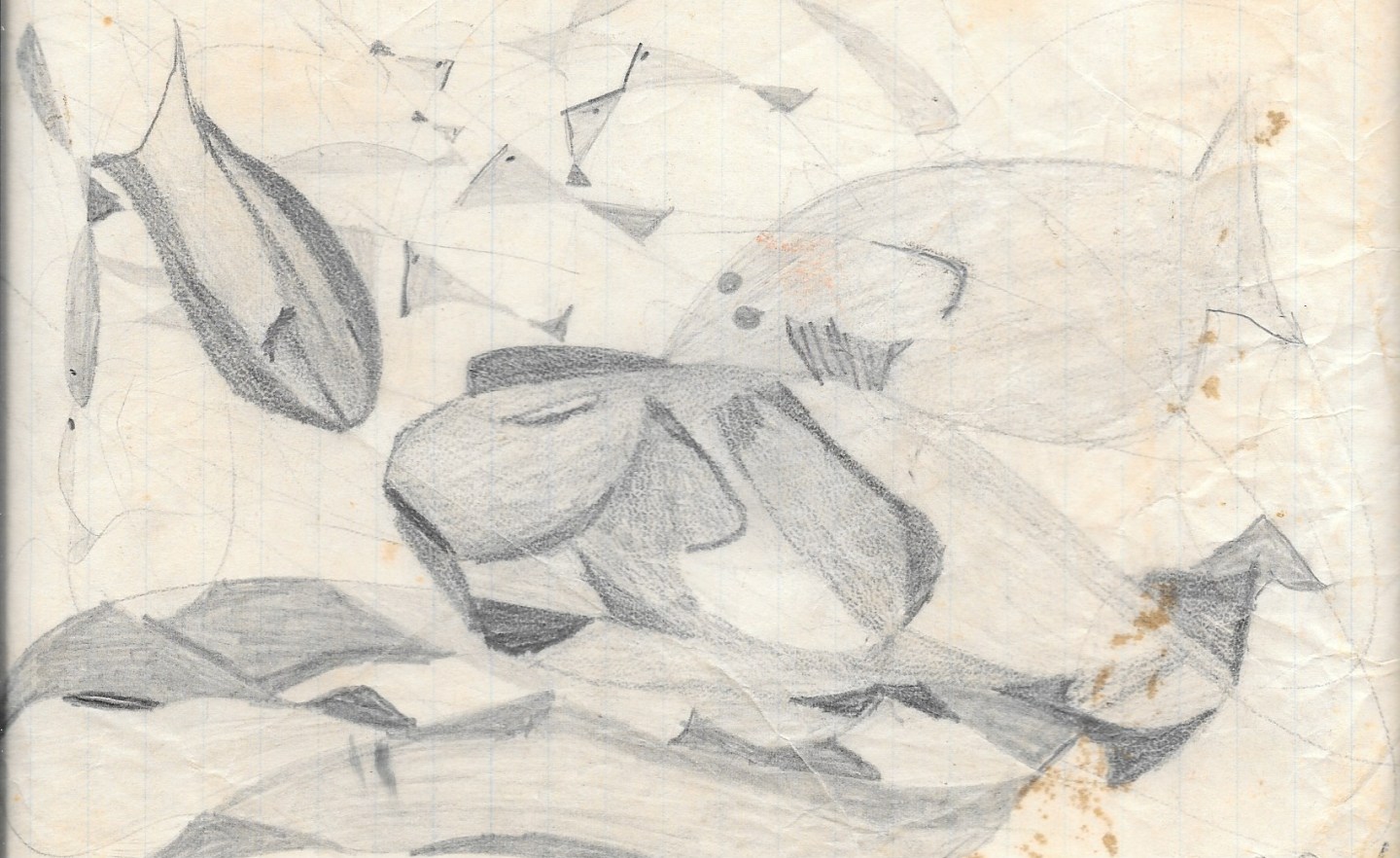
From inside the fish Jonah prayed to the Lord his God. He said:
“In my distress I called to the Lord,
and he answered me.
From deep in the realm of the dead I called for help,
and you listened to my cry.
You hurled me into the depths,
into the very heart of the seas,
and the currents swirled about me;
all your waves and breakers
swept over me.
I said, ‘I have been banished
from your sight;
yet I will look again
toward your holy temple.’
The engulfing waters threatened me,
the deep surrounded me;
seaweed was wrapped around my head.
To the roots of the mountains I sank down;
the earth beneath barred me in forever.
But you, Lord my God,
brought my life up from the pit.
“When my life was ebbing away,
I remembered you, Lord,
and my prayer rose to you,
to your holy temple.
“Those who cling to worthless idols
turn away from God’s love for them.
But I, with shouts of grateful praise,
will sacrifice to you.
What I have vowed I will make good.
I will say, ‘Salvation comes from the Lord.’”
And the Lord commanded the fish, and it vomited Jonah onto dry land.
- Jonah 2:1-10
Noted Biblical Scholars, Teachers, and Preachers Comments
Jonah 2:1-9 ‘The Warning to Nineveh’: “Having been given a second chance, Jonah goes straight to Nineveh and announces that it will be overthrown unless the people repent. To the prophet’s amazement and frustration, they repent, God relents, and Nineveh is spared. In the closing verses of the book, Jonah is rebuked by God because of his anger over the response of the people. Jonah had hoped they would be condemned and protested that he knew God would be merciful to his enemies Jonah 4:1-3). As much as any Old Testament book, Jonah highlights the universal appeal of God’s love and mercy-even to the unlovely and the unmerciful.”
- Tim LaHaye and Ed Hindson, Exploring Bible Prophecy
Jonah 2:1 ‘A prayer from a fish’s belly’: “What a strange place for prayer! Surely this is the only prayer that ever went up to God out of a fish’s belly. Jonah found himself alive-that was the surprising thing-and because he was alive, he began to pray. If we live with death so near and in so great peril, and yet do not pray, what is to become of us? This prayer of Jonah is remarkable because it is not a prayer at all in the sense in which we usually apply the word to petition and supplication. It is almost all thanksgiving, and the best prayer in all the world is a prayer that is full of thankfulness. We praise the Lord for what he has done for us, and thus we do, in effect, ask him to perfect the work he has begun. He has delivered us, so we bless his holy name, and by implication we request him to deliver us. Notice that it says here, ‘Jonah prayed to the LORD his God.’ He was a runaway. He had tried to escape from the presence of God, yet the Lord was still his God. God will not lose any of his people-even if, like Jonah, they are in the belly of a fish, Jehovah is still their God.“
- Charles H. Spurgeon, from sermon notes
Jonah 2:1 ‘God desires the best’: “God’s love desires the best for all of us, and He desires to give us the best at any cost. He will open rivers in desert places, still turbulent waves, quiet the wind, bring water from the rock, send an angel to release an apostle from prison, feed an orphanage, open a land long closed to the gospel. All these things and a thousand others He has done and will do in answer to prayer, but only because it had been His will to do it from the beginning. No one persuades Him.
“What the praying man does is to bring His will into line with the will of God so God can do what He has all along been willing to do. Thus prayer changes the man and enables God to change things in answer to man’s prayer.”
- A. W. Tozer, The Price of Neglect
Jonah 2:2-9 ‘praise and thanksgiving from the belly of a fish’: “Jonah began his prayer from the belly of the fish with praise and thanksgiving for God’s previous work in his life. … This prayer is structured as a psalm of thanksgiving, verifying that Jonah was not petitioning God for help but thanking him for undeserved deliverance. This thanksgiving for his undeserved deliverance stands in stark contrast to his own anger when God later delivered undeserving Nineveh. Like the poetic style of the psalms, this prayer is a beautiful flow of Jonah’s heartfelt thoughts (see Ps 120:1). Jonah’s use of ‘realm of the dead’ (Heb., lit. ‘the place of the dead’ or ‘the grave’) indicates that he thought he was at death’s door (Jnh 2:2). Again, the Lord rescued Jonah from physical death.”
- Dorothy Kelley Patterson, General Editor, NIV Woman’s Study Bible (Karen H. Jobes, Minor Prophets contributor)
Jonah 2:2 ‘out of the belly of Sheol’: “ The phrase does not necessarily indicate that Jonah actually died. ‘Sheol’ frequently has a hyperbolic meaning in contexts where it denotes a catastrophic condition near death (Ps. 30:3). Later Jonah expressed praise for his deliverance ‘from the pit,’ speaking of his escape from certain death.”
- John MacArthur, John MacArthur Commentary (quoted Scripture without bold/italics)
Jonah 2:3 ‘missing the resurrection’: ”We cannot treat this lightly. If Jonah lived in the fish, he also lived like a fish, because he was swamped by water. He says, ‘The floods compassed me about: all thy billows and thy waves passed over me.’ In other words, Jonah is saying, ‘I got wet.’ I think it is all wet to try to say that the man lived three days and three nights. I personally feel that the Devil gets us to argue about that, while we miss the great truth of the resurrection.”
- J. Vernon McGee, Thru the Bible, Vol III, Proverbs to Malachi
Jonah 2:4-6 ‘raised from the Pit’: “Jonah had been banished from God’s sight (2:4)_ He was out of fellowship with God. But then Jonah declared, you raised my life from the Pit (2:6).
“Have you ever been in the Pit? Are you there now? If so, there’s good news: The Pit is not a bad place to be if it gets you back into the will of God. When a visit to that place is what it takes to nudge you back on track spiritually, you can thank God for the Pit.”
- Tony Evans, The Tony Evans Bible Commentary (quoted Scripture without bold/italics)
Jonah 2:4 ‘I have been cast out of your sight’: “In 1:3, Jonah ran from the LORD’s presence; here he realizes that the Lord has temporarily expelled him.”
- John MacArthur, John MacArthur Commentary (quoted Scripture without bold/italics)
Jonah 2:5 ‘my soul’: “This describes Jonah’s total person—both physically and spiritually (cf. v. 7).”
- John MacArthur, John MacArthur Commentary (quoted Scripture without bold/italics)
Jonah 2:6 ‘the earth with her bars’: “’I went down to the bottoms of the mountains; the earth with her bars was about me for ever.’ This is a very interesting translation because it is in Elizabethan English; this is the way that death was spoken of. ‘The earth with her bars was about me for ever’—Jonah is speaking here of the bars of death, and that is the meaning of this translation.
“’Yet hast thou brought up my life from corruption, O LORD my God.’ ‘Corruption’ is death. The apostle Peter so used this word on the Day of Pentecost when he said that the Lord Jesus did not see corruption (see Acts 2:25–31). The miracle about the Lord Jesus is that when He died He did not see corruption—His body did not corrupt. That is the difference between Jonah’s experience and our Lord’s experience. Jonah did see corruption. His body apparently began to decay in those three days and three nights. ‘Yet hast thou brought up my life from corruption.’ What we have here, in my judgment, is a definite statement by Jonah that he died. The miracle here is resurrection, and that is a much greater miracle than for a man to live for three days inside a fish.
“I think it is very important that we have a book in the Old Testament which teaches the resurrection of Jesus Christ. The Resurrection is one of the two pillars of our salvation upon which the ark of the church rests—the death of Christ and the resurrection of Christ. They are both taught in the Old Testament, and this book illustrates His resurrection.”
- J. Vernon McGee, Thru the Bible, Vol III, Proverbs to Malachi
Jonah 2:7-9 ‘discipline with love’ : “When my son was young, I told him to empty the trash. He told me that he didn’t feel like it, but I assured him I could change the way he felt. And I did. Likewise, God changed the way Jonah felt because God loved him enough to do so. As a result, Jonah remembered that salvation belongs to the Lord; therefore, he was ready to fulfill what he had previously vowed (2:9).”
- Tony Evans, The Tony Evans Bible Commentary (quoted Scripture without bold/italics)
Jonah 2:8-9 ‘God’s grand truths are learned during hardship’: “Jonah learned this sentence of good theology in a strange college. He learned it in the whale’s belly, at the bottom of the mountains, with the weeds wrapped about his head. Most of the grand truths of God have to be learned by trouble. They must be burned into us with the hot iron of affliction, otherwise we will not truly receive them. No man is competent to judge in matters of the kingdom of God until he first has been tried-since there are many things to be learned in the depths that we can never know in the heights. We discover many secrets in the caverns of the ocean, which, though we had soared to heaven, we could never have known. He will best meet the needs of God’s people as a preacher who has had those needs himself. He will best comfort God’s Israel who has needed comfort. And he will best preach salvation who has felt his own need of it. When Jonah was delivered from his great danger, he was then capable of judging. And this was the result of his experience under his trouble: ’Salvation belongs to the LORD.’”
- Charles H. Spurgeon, from sermon notes
Jonah 2:8 ‘vanity is emptiness’: “I have tried to arrive at a satisfactory explanation of this verse, and so far I have been unable to do so. However, I will have to give you the explanation I have: This is another of the great principles in Scripture. Vanity is emptiness. Jonah is speaking here of those who observe that which is empty, that which is vain, that which is just a dream and is not going to come to pass. Jonah calls it a lying emptiness. He says that they forsake the only mercy they can receive. Jonah says at this time, ‘I called out to the living and true God. I no longer was playing the pouting prophet, rushing off to Tarshish in the opposite direction because I hated the Ninevites and didn’t want them saved. Now I am dealing with reality. I’m getting right down to the nitty-gritty.’ (And, my friend, there was a whole lot of nitty-gritty inside that fish!) This man says, ‘I’m getting right down to business with God. I appealed to Him, to His mercy, and I found that He was merciful to me.’”
- J. Vernon McGee, Thru the Bible, Vol III, Proverbs to Malachi
Jonah 2:9 ‘I have vowed.’: “Jonah found himself in the same position as the mariners: offering sacrifices and making vows (cf. 1:16). In light of 3:1–4, Jonah’s vow could well have been to carry out God’s ministry will for him by preaching in Nineveh (Pss. 50:14; 66:13, 14).”
- John MacArthur, John MacArthur Commentary (quoted Scripture without bold/italics)
Jonah 2:10 ‘The fish says, “out with you.”’: “You do not always get an opportunity to right a wrong. But Jonah did. You do not always get a second chance: But Jonah did. In a famous section of William Shakespeare’s drama, Julius Caesar, Brutus urges Cassius to enter battle with Octavius and Anthony. Brutus advocates that a missed opportunity will be lost forever.”
- Jay McCluskey, A Long Walk with the Minor Prophets
My Thoughts
Jonah prayed from inside the fish.
He was engulfed by the waves, tossed about. Seaweed wrapped around Jonah’s head. Jonah went to the bottom.
But then, God raised Jonah from the pit.
The scholars are torn on this. Did Jonah die? If he did, then Jesus saying the “sign of Jonah” was indeed one resurrection after three days like the other. It may have been a near death experience. Like some people who are clinically dead for minutes or hours, they come back a tell the tale of what they saw in Heaven. So, was this prayer in an out of body state? Or his thoughts when he is going to Heaven? Or was he conscious or nonconscious inside the fish praying this prayer, and somehow breathing air?
God could have worked out the miracle in any of these scenarios. And Jonah could have considered himself as good as dead at that point. Who had ever come back from near-drowning and then swallowed by a fish?
But verse seven is the turning point, when his life was ebbing away, he remembered God and he called out to Him.
Verse eight is a break in the flow of this prayer unless you remember what God asked of Jonah. It is a basic fact that those who serve worthless idols turn their back on God.
But, Jonah will go to Nineveh and proclaim that salvation comes from the Lord.
At that point, God commands the fish to vomit Jonah onto dry land.
I wrote last week about how God could have created a fish just for this purpose. He could have had angels form into a fish. And if this was a fish built just for this purpose, then not having bones in the fossil record makes sense. If every species on earth has huge gaps in the fossil records, a one-of-a-kind fish could easily hide on the bottom of the sea.
But in this chapter, what is the unknown? Was Jonah alive, dead, or in some type of suspended animated state between the two? But whatever state Jonah was in, he survived it.
He lived to tell the tale – although people only assume Jonah wrote this book. There is no signature style statement. And unlike most of the minor prophets, and much of the major prophets, this book is in narrative prose form, except for this chapter. His prayer is in a poetic form.
And as many of the scholars stated, we learn the most about God and ourselves when we are hit with hard times. When suffering the greatest, we find out more about God, and we learn our reaction to these hard times. Do we turn back to God or do we find a dark shadow where we can sulk.
We will get to Jonah sulking, but not yet.
Some Serendipitous Reflections
Jonah 2 1. When have you felt like Jonah-far from God, enmeshed in a situation beyond your control? How then was your life brought ‘up from the pit’?
“2. Where in your life are you desperate enough to pray with hope, as Jonah does?”
- Lyman Coleman, et al, The NIV Serendipity Bible for Study Groups
Jonah 2 has one set of questions.
Substitute whatever group for any reference to a small group or ask who could come to your aid.
If you like these Thursday morning Bible studies, but you think you missed a few, you can use this LINK. I have set up a page off the home page for links to these Thursday morning posts. I will continue to modify the page as I add more.
Soli Deo Gloria. Only to God be the Glory.


Leave a Reply