Consecrate the fiftieth year and proclaim liberty throughout the land to all its inhabitants. It shall be a jubilee for you; each of you is to return to your family property and to your own clan.
- Leviticus 25:10
“Whitechapel Bell Foundry in London forged the Pennsylvania State House Bell and shipped it to America. When it arrived in Philadelphia in August 1752, the city buzzed with excitement and everyone gathered to see the bell and hear its glorious tone. Workers erected a makeshift stand, and the bell was rung with such force that, to the horror of all present, it cracked with the first strike of the clapper!
“Norris wrote a furious letter to the Whitechapel Foundry, which claimed the bell must have been damaged in transit. The cracked bell was taken down and entrusted to John Pass and John Stow, Philadelphia metalworkers. They created a new mold before taking sledgehammers and shattering the bell into small pieces, which were then melted down and remolded in the cast. When the second bell was unveiled, the population of Philadelphia came out again. The city council provided a feast of meats, cheeses, potatoes, bread, and beer.3 The moment came, and a worker again struck the clapper to the side of the bell. This time it didn’t crack-but neither did it ring. It clunked.
“The bell was again smashed to pieces, melted down, and recast. On June 7, 1753, workers hoisted the third version of the one-ton bell into the steeple of the State House. Many people still didn’t like its tone, but it started doing its official work, summoning the Pennsylvania colonial legislators to session. It was also used to announce the news of the day-the accession of George III to the British throne, the end of the French and Indian War, and, increasingly, the politics of the Revolution. As a British ship sailed up the Delaware River to deliver the dreaded Stamp Act to America, the State House bell rang to warn the city. For the next decade, the Old State House bell rang at every major step along the road to the Revolutionary War. Its most famous moment came at 11:00 a.m. on July 8, 1776, when it summoned people to Independence Hall to hear the reading of the Declaration of Independence. Afterward all the bells of all the churches in Philadelphia pealed until the evening.”
- Robert J. Morgan, 100 Bible Verses That Made America
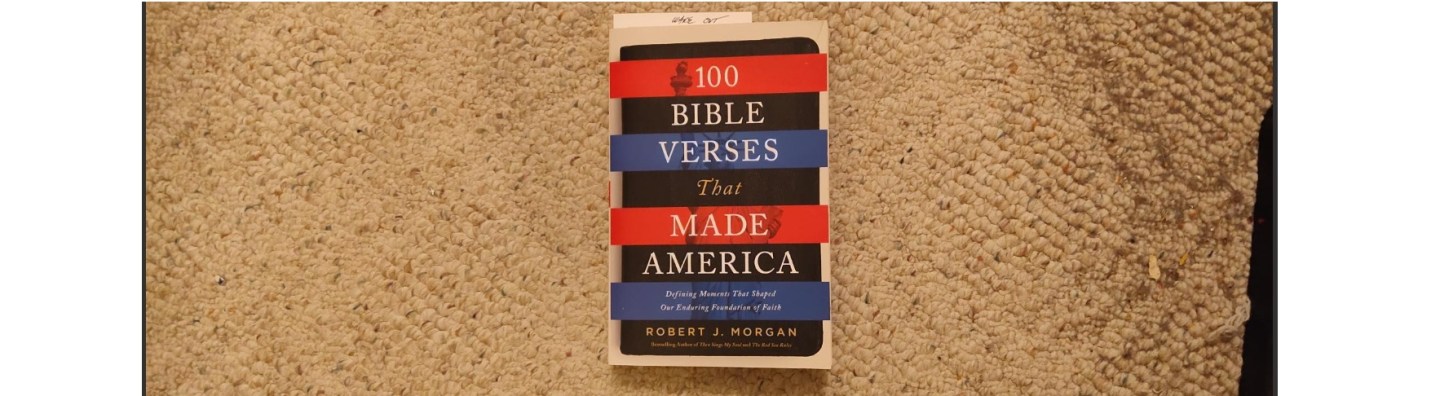
In my recent trip to visit the grandchildren, the oldest of them went with me to Nashville, to sell used books and games. One of the books that I purchased in return was 100 Bible Verses That Made America by Robert J. Morgan. As we approach the 250th anniversary of the birth of the USA, I thought I would do a condensed mini-series on some of these verses, four posts per week for a few weeks – maybe not all 100 verses.
First, the reason to get the bell:
William Penn hung a bell from a tree in the settlement of Philadelphia. He would ring the bell and everyone would come to hear the latest news. But as the city got bigger, the small bell could not be heard by everyone. Isaac Norris, the speaker of the legislature, ordered a larger bell, and he had a bell tower built.
Second, the myth busted:
I had always been told that the bell cracked on the Fourth of July of 1776. A totally fabricated myth. Oddly with the first and third bells made of the same bronze cracking, neither in 1776.
Third, the science:
The bell was made of bronze, 70% copper, 25% tin, and the other five percent was lead, zinc, arsenic, gold, and silver. Most metals have certain grades that can be crack sensitive. It might take only a small variance in one ingredient or another in the alloy.
I did not work with bronze, but steel has similar crack sensitive grades. There are certain grades of steel that are crack sensitive. The original bell was not damaged in transit. They cast the bell, and as they cooled down the bell, they failed to be careful at a critical point when certain crystalline structures are formed.
Why would they use such grades of bronze with something that will be rung with a clapper? After all, you are hitting one hard thing with the other hard thing. Sometimes there are qualities that you want. The bell needed to be hard, maintaining its shape during the beating that it would get. And it could have been the tone of the bell that was most important.
What does the Bible verse have to do with the bell?
The verse was cast as part of the bell. Yes, the speaker of the legislature insisted on the Bible verse.
When the British army moved into Philadelphia. The Pennsylvanians moved the bell into hiding. After the war, the bell was again hoisted into the tower. No one really knows when the third bell made from the same original metal cracked, but the bell, without its clapper, became a symbol of liberty when slavery was abolished. Due to the verse written on the bell, it was at this time when they called it the Liberty Bell.
It took the United States a while before they abolished slavery. It is illegal. There are still people in the USA that have been purchased, as there are in other countries, yet the world generally agrees that slavery is a bad idea.
There are also ways to have tyranny over other people all over the world. This should not be allowed, and there are watch dog groups that try to bring to light governments that do not allow basic human rights for their people. We do not get things right. We as a collection of countries on earth are still a work in progress. We should stand for the oppressed, but sometimes the media ignores the human rights violations in certain countries. Sometimes stronger nations oppress third-world nations for the hidden resources in that country, and the world says nothing.
For those of us who are Christians, who try to live by what the Bible says, we should not be silent. When the oppressed people hurt, it should hurt us.
Soli Deo Gloria. Only to God be the Glory.


Leave a comment